
Key takeaways
- The global mood in 2026 is mixed: more people feel their lives are improving, but many still feel stressed, worried, sad, or emotionally tired day to day.
- Happiness is not only about feeling good today. It also includes life satisfaction, social support, safety, trust, freedom, work, and hope for the future.
- The happiest countries tend to have strong social trust, public support, safety, freedom, and stable systems.
- Younger people are one of the biggest warning signs, with Gen Z and Millennials facing pressure from social media, loneliness, housing costs, unstable work, and future uncertainty.
- Work can improve life satisfaction, but it can also increase stress, especially for managers, hybrid workers, and remote-capable workers.
Intro
The mood of the world is not easy to describe in one sentence.
People are not simply happy or unhappy. The better answer is that many people are rating their lives more positively than before, but they are still carrying a lot of stress, worry, sadness, and pressure in everyday life.
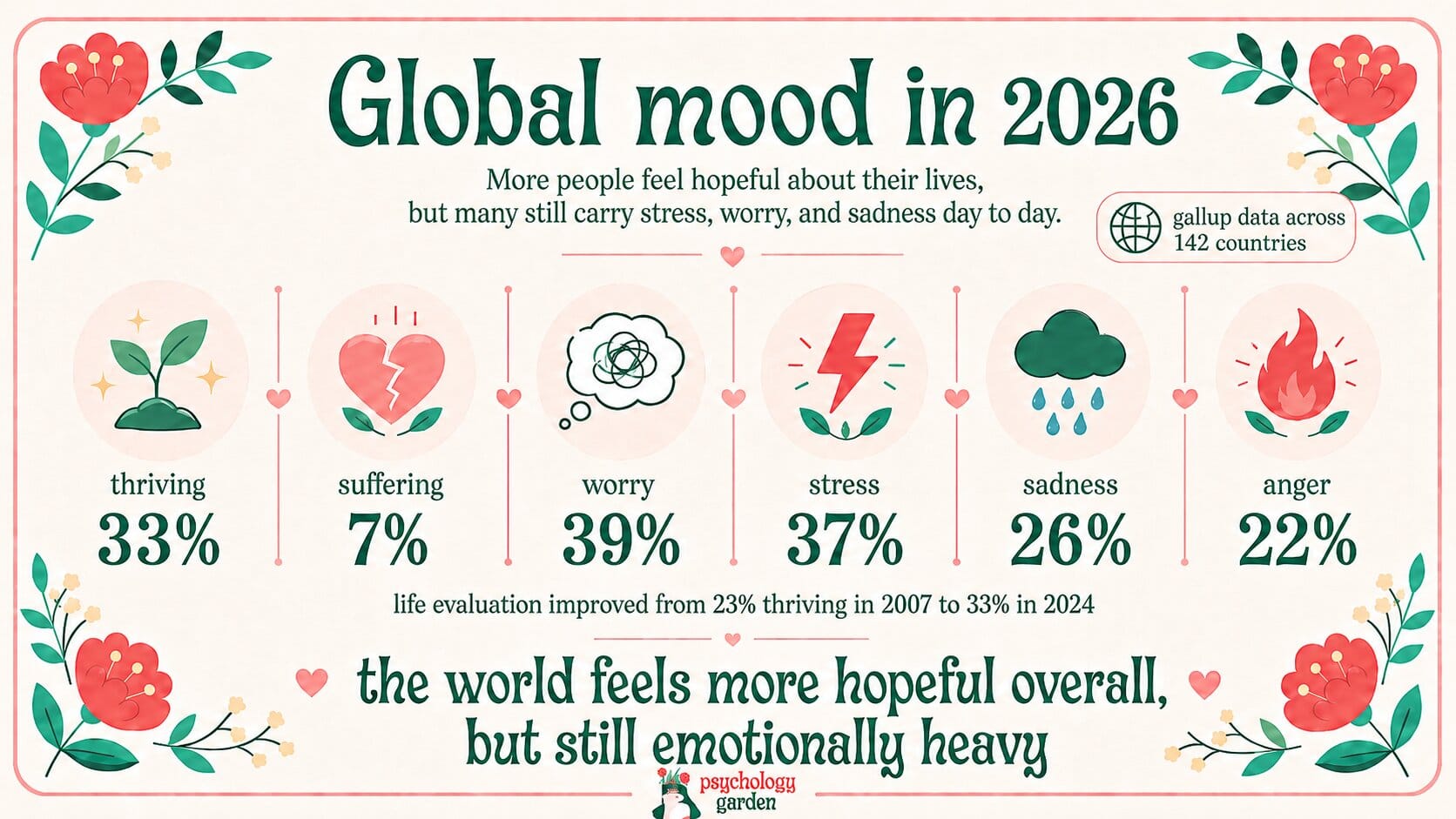
This is the main pattern in the latest global well-being data. According to Gallup, more adults around the world are now considered “thriving” than in the late 2000s. In 2024, 33% of adults across 142 countries were classified as thriving, while 7% were classified as suffering.
At first, this sounds hopeful. It suggests that more people believe their lives are going in a good direction.
But daily emotions tell a more complicated story. In 2024, Gallup found that 39% of adults worldwide felt worry a lot of the previous day, 37% felt stress, 26% felt sadness, and 22% felt anger.
So the world is not emotionally calm.
A simple way to understand it is this:
People may feel that life is improving overall, but many still feel tired, uncertain, pressured, or emotionally stretched in daily life.
The happiest countries are mostly places with strong social trust, good public systems, safety, freedom, and social support. Finland, Iceland, Denmark, Costa Rica, Sweden, Norway, the Netherlands, Luxembourg, and Switzerland are among the happiest countries in the 2026 World Happiness Report.
The least happy countries are mostly places affected by war, poverty, insecurity, weak institutions, and long-term economic stress. Afghanistan is at the bottom of the ranking, followed by countries such as Sierra Leone, Malawi, Zimbabwe, Botswana, Yemen, Lebanon, the Democratic Republic of the Congo, Egypt, and Tanzania.
Gender differences are also not simple. Women may report slightly higher life evaluation in some datasets, but they also report more stress and sadness in workplace data. This suggests that someone can feel their life has meaning or direction while still carrying a heavy emotional load.
Younger people are one of the biggest warning signs. Gen Z and younger Millennials are facing a different kind of emotional pressure than older generations. Social media, loneliness, housing costs, unstable work, climate anxiety, and future uncertainty all seem to shape their mood.
Work is another major part of the picture. Managers, hybrid workers, and remote-capable workers often report higher life satisfaction, but also higher stress. This shows that better jobs do not always mean easier emotional lives.
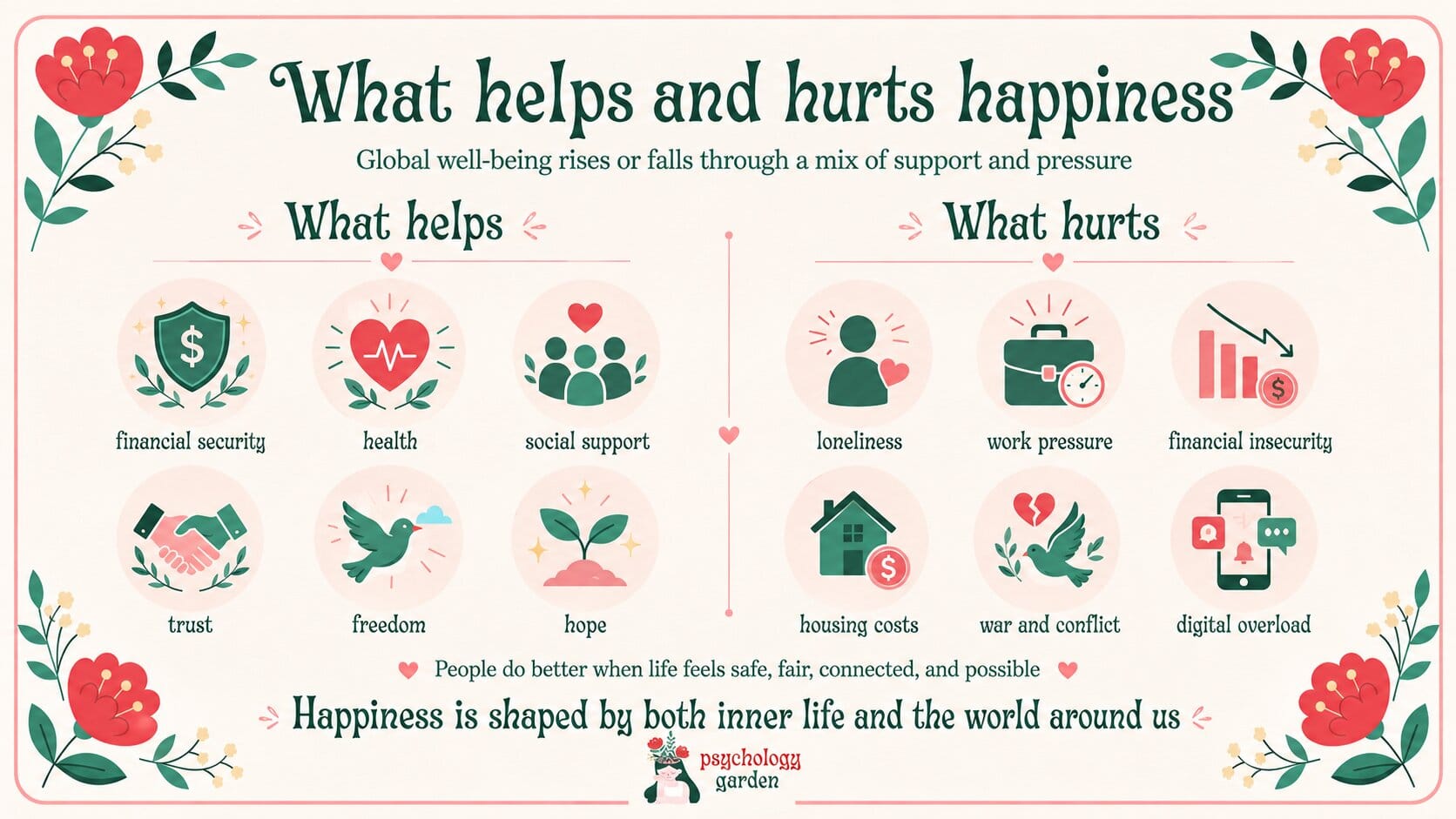
The biggest drivers of happiness are financial security, health, social support, trust, freedom, safety, good work, and hope for the future.
The main takeaway is this:
The world is somewhat more hopeful, but still emotionally heavy.
What do I mean by global mood?
When I talk about the “mood of the world,” I am not talking about one simple feeling.
Mood can mean how people feel today. It can also mean how they judge their life as a whole. These are connected, but they are not the same.
For example, someone can feel stressed today and still believe their life is going well. Another person might laugh and enjoy a good day, but still feel unhappy with their life overall.
Understanding your emotions can help explain why stress, sadness, worry, and even happiness show up for different reasons.
This is why global happiness research usually looks at different layers of well-being.
- The first layer is life satisfaction. This means how people rate their life as a whole.
- The second layer is daily emotion. This includes stress, worry, sadness, anger, enjoyment, laughter, rest, and respect.
- The third layer is social well-being. This includes whether people feel supported, connected, safe, and able to trust others.
- The fourth layer is work well-being. Work affects money, routine, identity, stress, time, and relationships, so it plays a huge role in people’s mood.
Looking at all of these together gives a more honest picture.
The world is not just happy or unhappy. It is layered.
The overall global mood
The overall global mood is mixed.
On one side, life evaluations have improved. Gallup reports that the share of people classified as thriving increased from 23% in 2007 to 33% in 2024. The share of people classified as suffering fell to 7%.
This suggests that more people feel their lives are moving in a better direction.
Still, the emotional side of the data is heavier.
A large part of the world still feels stress, worry, sadness, or anger on a normal day. Gallup’s 2024 emotional health data shows that 39% of adults felt worry, 37% felt stress, 26% felt sadness, and 22% felt anger the previous day.
That means many people are functioning, working, planning, and hoping, but not necessarily feeling calm.
This is important because happiness is not only about optimism. It is also about how safe, supported, rested, and emotionally steady people feel in everyday life, which is why psychology research often looks beyond one simple happiness score.
A person can say, “My life is better than before,” and still feel exhausted.
That seems to be the emotional shape of the world right now.
The happiest countries in the world
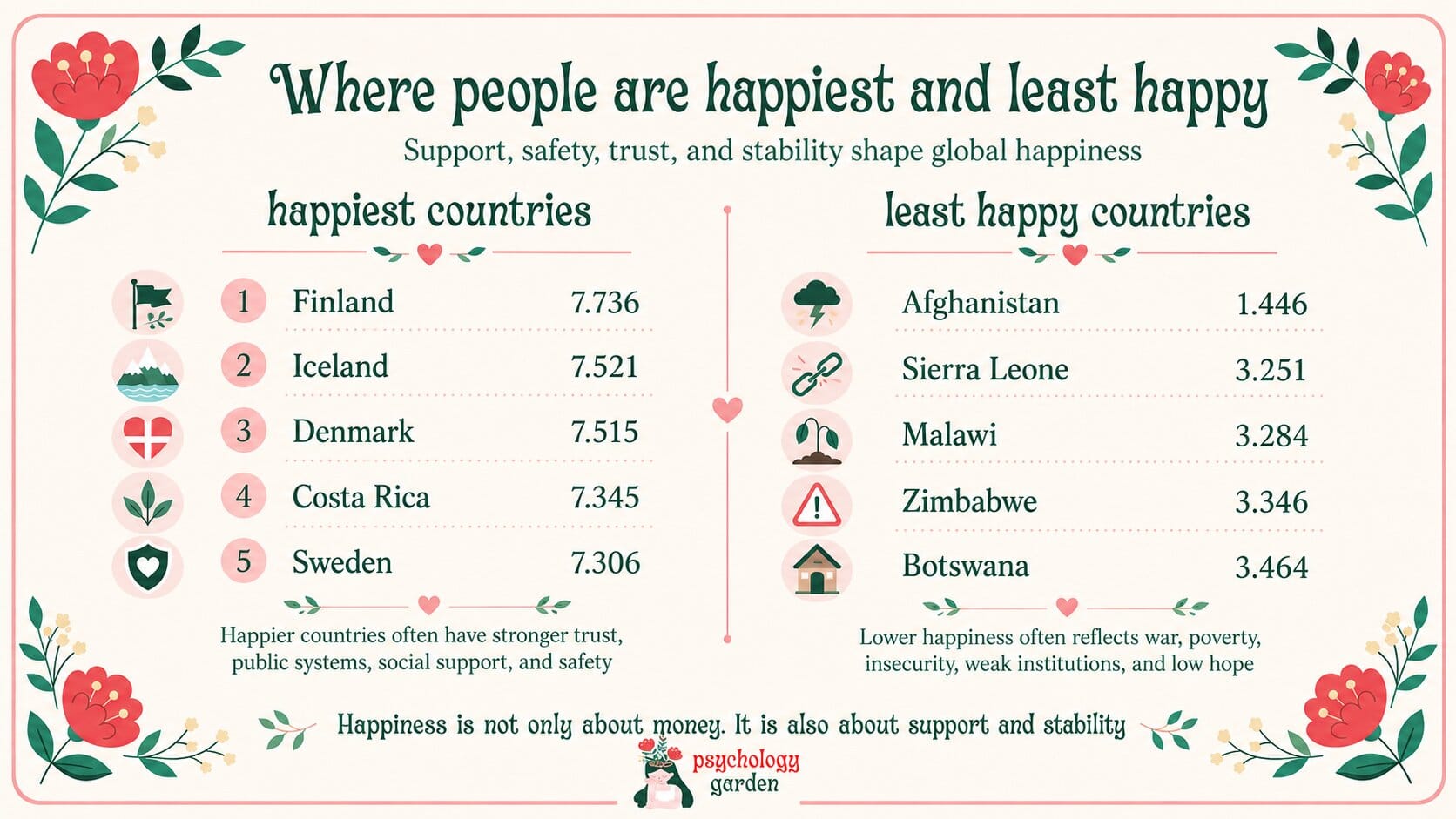
The happiest countries in the 2026 World Happiness Report are mostly countries where people feel safe, supported, and able to trust the society around them.
| Rank | Country | Happiness score |
|---|---|---|
| 1 | Finland | 7.736 |
| 2 | Iceland | 7.521 |
| 3 | Denmark | 7.515 |
| 4 | Costa Rica | 7.345 |
| 5 | Sweden | 7.306 |
The Nordic countries are still very strong. Finland, Denmark, Iceland, Sweden, and Norway often appear near the top because they combine comfort with trust.
This does not mean people there are happy every minute. It means people are less likely to feel abandoned when life becomes hard.
They usually have better access to public services, healthcare, education, safety, social protection, and work-life balance. These things make life feel less fragile.
Costa Rica is also interesting because it shows that happiness is not only about being the richest country. Social connection, health, culture, family life, and a sense of community can also support happiness.
In simple terms, the happiest countries are not just places where people have money. They are places where people feel supported.
The least happy countries
The least happy countries are usually places where people face several difficulties at once.
| Rank | Country | Happiness score |
|---|---|---|
| 147 | Afghanistan | 1.446 |
| 146 | Sierra Leone | 3.251 |
| 145 | Malawi | 3.284 |
| 144 | Zimbabwe | 3.346 |
| 143 | Botswana | 3.464 |
Afghanistan is at the bottom of the ranking by a large distance.
This is not surprising when we think about what happiness depends on. People need safety, freedom, health, food security, education, income, and hope. When these things are missing or unstable, life satisfaction becomes much lower.
Low happiness is rarely caused by one thing only. It is usually a stack of problems: poverty, conflict, corruption, weak institutions, poor healthcare, unemployment, low freedom, and insecurity.
This is why global happiness is also a question of fairness. Some people are trying to build a good life in conditions that make basic emotional safety very difficult.
Regional mood differences
Different regions of the world show different emotional patterns.
Northern Europe remains one of the happiest regions. People there often benefit from strong social trust, good public systems, safety, and work-life balance.
Western Europe still has high life satisfaction, but there are warning signs. Youth well-being, housing costs, loneliness, and stress are becoming more visible.
North America has high life evaluation, but also high stress. Gallup’s workplace data shows that the United States and Canada have some of the highest employee stress levels, with 50% of employees reporting stress a lot the previous day.
Latin America and the Caribbean often perform better emotionally than income alone would suggest. Social connection, family life, and community may help protect well-being, even when economic problems are present.
The Middle East and North Africa show higher stress and lower thriving in many datasets. Conflict, political instability, unemployment, and uncertainty all affect mood.
Sub-Saharan Africa has lower average life evaluation, mostly because of poverty, health challenges, insecurity, and fewer economic opportunities. Still, some communities may report strong connection and emotional resilience.
South Asia is one of the more concerning regions in workplace data. Gallup reports low employee thriving and high sadness in the region.
East Asia and Southeast Asia are mixed. Some countries have strong economic growth, but work pressure can be high, especially in East Asia.
The regional picture shows something important:
A country can be economically successful and still emotionally stressed.
Male vs female mood
There is no simple answer to whether men or women are happier.
The data depends on what we are measuring.
In Gallup’s workplace data, female employees were slightly more likely to be thriving than male employees. In 2025, 37% of female employees were thriving compared with 33% of male employees.
But women also reported more stress. Gallup found that 43% of female employees experienced stress a lot the previous day, compared with 39% of male employees.
This means women may report that their lives are going well overall, while still feeling more daily pressure.
That makes sense when we think about the extra emotional and practical load many women carry.
Women often do more unpaid care work. They may carry more family responsibility, emotional labor, safety concerns, workplace pressure, and social expectations. In some countries, women also face stronger restrictions on freedom, education, work, and independence.
Men also face their own emotional risks. In many cultures, men are taught to hide sadness, fear, or loneliness. They may have fewer close emotional friendships and may be less likely to ask for support. Work and income pressure can also strongly affect male identity and self-worth.
So the gender difference is not about one side having an easier life. It is more accurate to say that men and women may struggle in different ways, and some of those struggles are measured more clearly than others.
Mood by generation
Generational mood is one of the most important parts of this topic.
Younger people are not always the happiest group anymore. In some countries, especially richer English-speaking countries, young people are showing weaker well-being than older adults.
This matters because youth is supposed to be a time of possibility. But for many young people, it now comes with pressure, comparison, uncertainty, and fear about the future.
A simple generational pattern looks like this:
| Generation | General mood pattern |
|---|---|
| Gen Z | More exposed to social media, anxiety, comparison, loneliness, and uncertainty |
| Millennials | Pressured by housing, career instability, debt, relationships, and family planning |
| Gen X | Often balancing work, children, aging parents, and financial responsibility |
| Boomers | Often report higher life satisfaction, but may face health issues and loneliness |
Gen Z is especially important.
Many young people are growing up with constant digital comparison. They see other people’s beauty, success, relationships, money, travels, opinions, and achievements all day. Even when they know social media is edited, it can still affect how they see themselves.
But social media is not the only reason. Young people also face expensive housing, unstable jobs, climate anxiety, political distrust, loneliness, and pressure to figure everything out quickly.
Millennials have a different kind of stress. Many are adults with responsibilities, but still feel delayed by the economy. Buying a home, raising children, building savings, or feeling financially secure can be harder than expected.
Gen X often carries a quiet kind of pressure. Many are in the middle of caring for children, supporting parents, managing work, and thinking about their own health and future.
Boomers often report higher happiness, partly because many have more stable finances, offline social habits, and settled life structures. But this does not mean all older people are doing well. Loneliness, illness, grief, and loss of identity after retirement can still affect mood deeply.
The generational story is not “young people are weak.” It is that young people are growing up in a world that is emotionally noisy, expensive, uncertain, and always online.
Mood by work and jobs
Work affects mood because it takes up so much of life.
It affects income, routine, identity, confidence, stress, sleep, relationships, and free time.
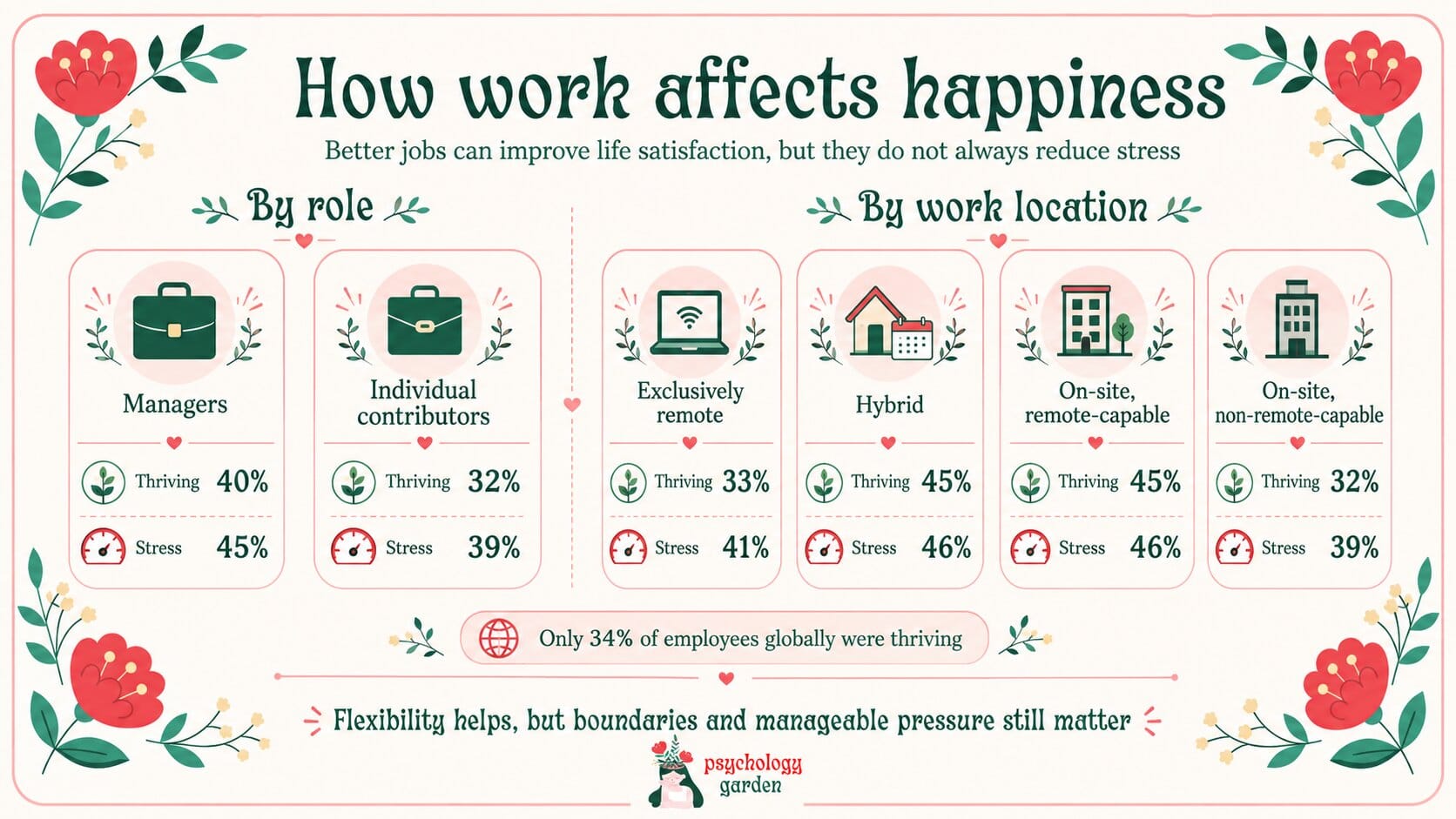
Gallup’s 2026 workplace data shows that only 34% of employees globally were thriving. Most workers were either struggling or suffering.
This does not mean most people hate their jobs. It means work is not giving many people enough stability, meaning, respect, or emotional balance.
Managers
Managers are more likely to be thriving, but they are also more stressed.
| Job level | Thriving | Stress |
|---|---|---|
| Managers | 40% | 45% |
| Individual contributors | 32% | 39% |
This makes sense. Managers may have higher income, more control, and more career status. These things can improve life satisfaction.
But they also deal with pressure, responsibility, conflict, targets, decisions, and other people’s emotions. So managers may have better lives on paper, but more stressful days.
Hybrid and remote workers
Work location also affects mood.
| Work location | Thriving | Stress |
|---|---|---|
| Exclusively remote | 33% | 41% |
| Hybrid | 45% | 46% |
| On-site, remote-capable | 45% | 46% |
| On-site, non-remote-capable | 32% | 39% |
Hybrid workers and remote-capable workers are more likely to be thriving. This may be because these jobs often come with more flexibility, higher pay, more autonomy, and better career options.
But they also report high stress. This shows that flexibility is helpful, but it does not automatically solve work pressure.
Remote and hybrid work can blur the line between work and rest. People may feel always available. Messages, meetings, notifications, and deadlines can follow them home.
So again, the picture is layered.
Some jobs give people more freedom, but also more mental load. Over time, constant pressure and emotional exhaustion can make even simple tasks feel harder to start. Understanding why motivation disappears can help explain why someone may still want to act but feel mentally or physically unable to begin.
Which jobs are usually happiest?
There is no perfect global ranking of every job by happiness.
But we can see patterns.
Jobs tend to support happiness when they offer:
- fair pay
- stability
- autonomy
- respect
- safety
- meaningful work
- supportive managers
- predictable hours
- good relationships
- room to grow
Jobs tend to hurt mood when they include:
- low pay
- insecurity
- long hours
- poor management
- emotional exhaustion
- unsafe conditions
- low control
- unclear expectations
- constant pressure
- little recognition
This means the happiest jobs are not always the most glamorous jobs.
A job can be good for mood if it gives someone dignity, structure, purpose, and enough energy to still have a life outside work.
A high-paying job can still be emotionally damaging if it destroys sleep, health, relationships, and peace.
A lower-paying job can still feel good if it is stable, respectful, meaningful, and balanced.
The best work is not only work that pays. It is work that lets people remain human.
What makes people happier?
The biggest happiness drivers are simple, but not always easy to achieve.
Financial security
Money matters because it creates safety. It helps people pay rent, buy food, access healthcare, support family, and plan for the future. Money does not guarantee happiness, but not having enough money creates constant stress.
Health
Health affects almost everything. When people feel physically or mentally unwell, life becomes smaller. Energy drops. Sleep suffers. Work becomes harder. Relationships can feel heavier. Good health gives people more freedom.
Social support
People are happier when they have someone to rely on. This can be family, friends, partners, neighbors, colleagues, or community. Social connection is also one of the natural rewards processed by the brain reward system, which helps explain why feeling supported can be so important for wellbeing.
Trust
Trust makes life feel lighter. When people trust others, they do not have to feel guarded all the time. When they trust institutions, they feel more protected by society. Low trust creates emotional exhaustion.
Freedom
People need to feel that they have some choice in their life. Freedom to choose where to live, who to love, what to study, what work to do, and how to express yourself is strongly connected to happiness. When people feel trapped, mood drops.
Good work
Work can give people purpose, money, identity, and connection. But bad work can create stress, burnout, shame, and exhaustion. Good work supports people. Bad work drains them.
Safety
Safety is one of the deepest emotional needs. When people live with war, violence, crime, political fear, or instability, happiness becomes much harder. Peace gives people space to think about the future.
Hope
Hope is not the same as pretending everything is fine. Hope means people can still imagine that life can improve. When people lose hope, even small problems can feel much heavier.
What is hurting the global mood?
The biggest risks to global mood are:
| Risk | Why it matters |
|---|---|
| Youth anxiety | Affects future mental health, relationships, and trust |
| Loneliness | Makes stress feel heavier |
| Work pressure | Affects daily life, sleep, and family time |
| Financial insecurity | Creates constant worry |
| Housing costs | Makes young adulthood feel unstable |
| War and conflict | Destroy safety and hope |
| Low trust | Makes people feel unsupported |
| Digital overload | Increases comparison and stress |
| Health problems | Reduce freedom and energy |
| Inequality | Makes life feel unfair |
The world’s emotional pressure does not come from one place. It comes from many small and large pressures stacking on top of each other. That is why people can look “fine” and still feel overwhelmed.
Final thoughts
The world is not simply getting happier or sadder. It is more complicated than that.
More people may feel that their lives are improving, but many still feel stressed, worried, lonely, or emotionally tired in daily life.
The happiest countries show us that well-being is not only about money. It is also about trust, safety, freedom, support, health, and feeling that life is not something you have to survive alone.
The least happy countries show how much suffering grows when people lose safety, stability, freedom, and hope.
Gender differences show that men and women may carry different emotional burdens.
Generational differences show that young people need more attention, not judgment.
Workplace data shows that success and stress can exist at the same time.
The main lesson is simple:
People do better when life feels safe, fair, connected, and possible.
Happiness is not just a private feeling. It is also shaped by the world people have to live in.
FAQs
The happiest countries in 2026 are mostly places with strong social trust, safety, freedom, social support, and good public systems. Finland, Iceland, Denmark, Costa Rica, and Sweden are among the happiest countries mentioned in the article.
Younger people are facing pressure from social media, loneliness, high housing costs, unstable work, climate anxiety, and uncertainty about the future. Gen Z and Millennials may feel especially emotionally stretched because they are growing up or building adult lives in a world that feels expensive, noisy, and unpredictable.
Yes, work can strongly affect happiness because it shapes income, stress, routine, identity, sleep, and relationships. Good work can give people purpose, stability, and confidence, while stressful or unsafe work can lead to emotional exhaustion and lower well-being.
People are usually happier when they have financial security, good health, social support, trust, freedom, safety, meaningful work, and hope for the future. These factors make life feel more stable, supported, and emotionally manageable.
People can feel hopeful and stressed at the same time because life satisfaction and daily emotions are not the same thing. Someone may believe their life is improving overall, but still feel tired, worried, pressured, or emotionally stretched in everyday life.
No, richer countries are not always happier. Money and financial security matter, but happiness also depends on trust, health, safety, social connection, freedom, meaningful work, and hope for the future.