Key takeaways:
- An analysis of 1,100 comments from a large Reddit thread found that many adults with ADHD or autism spent years assuming their internal experiences were universal.
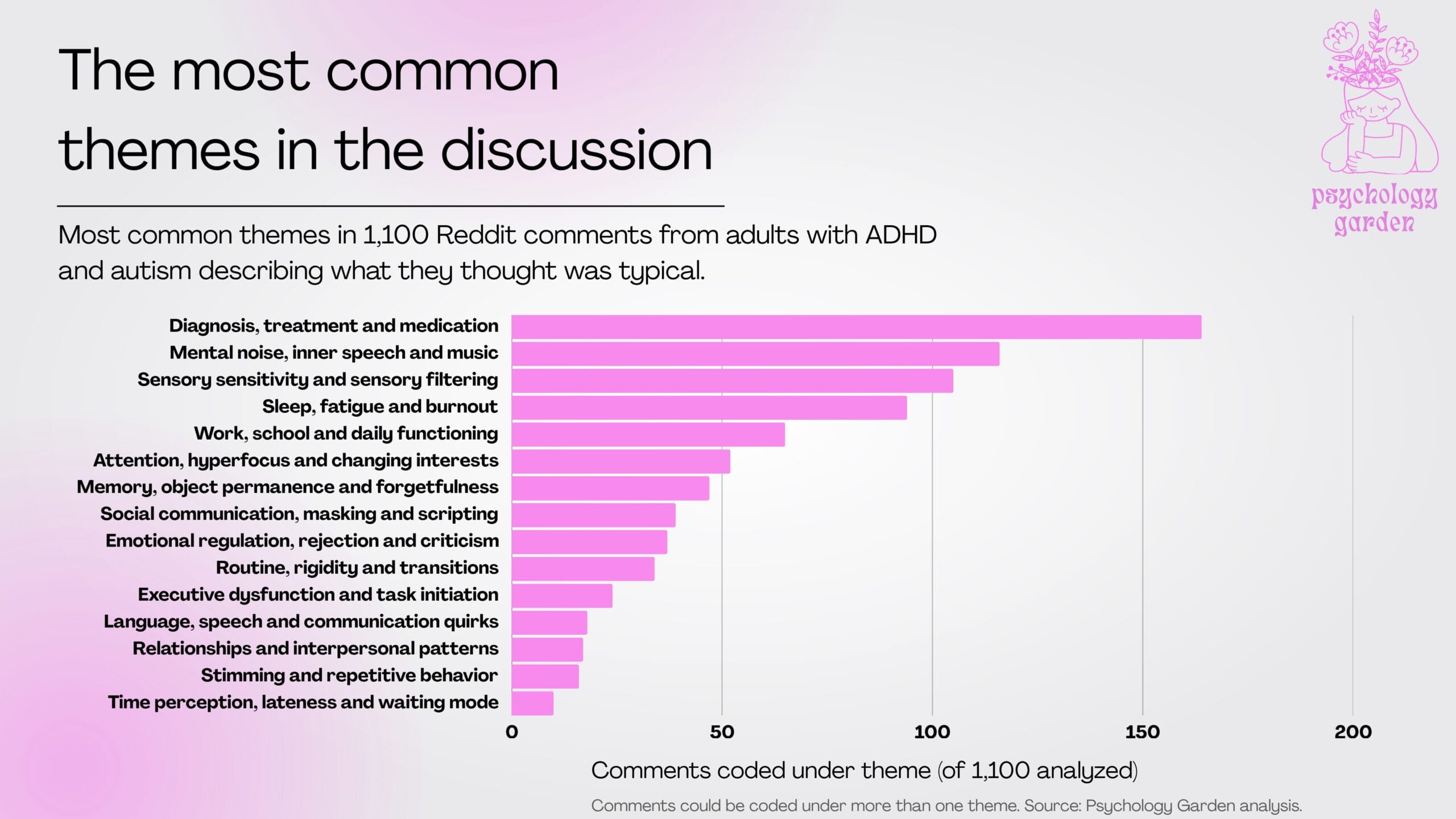
- Diagnosis, treatment and medication was the most common theme (164 comments), with many Redditors describing diagnosis as the moment their past finally made sense.
- Constant mental noise (116 comments) and sensory sensitivity (105 comments) were the next most frequent themes, followed by sleep problems and burnout (94 comments).
- Because they believed everyone’s mind was equally loud or equally overwhelmed, many commenters concluded they simply had less discipline or self-control than other people.
Intro
This article describes experiences shared in a public online discussion and is not medical advice or a diagnostic tool; if you recognize yourself in these patterns, a qualified clinician is the right next step.
When something has been part of your life for as long as you can remember, it is easy to assume that everyone else experiences it too. A close friend of mine constantly notices things I don’t even register, and she’ll ask, “How did you not see that?”, assuming my brain works exactly like hers. I do the same to her in reverse. We all do it.
In my country, mental health is still considered a taboo topic, especially when it comes to diagnoses such as ADHD. My therapist says that ADHD is far less researched and discussed than anxiety or depression. However, she has also noticed a growing number of clients recognizing possible ADHD symptoms in themselves, suggesting that awareness is increasing when it comes to going to psychotherapy.
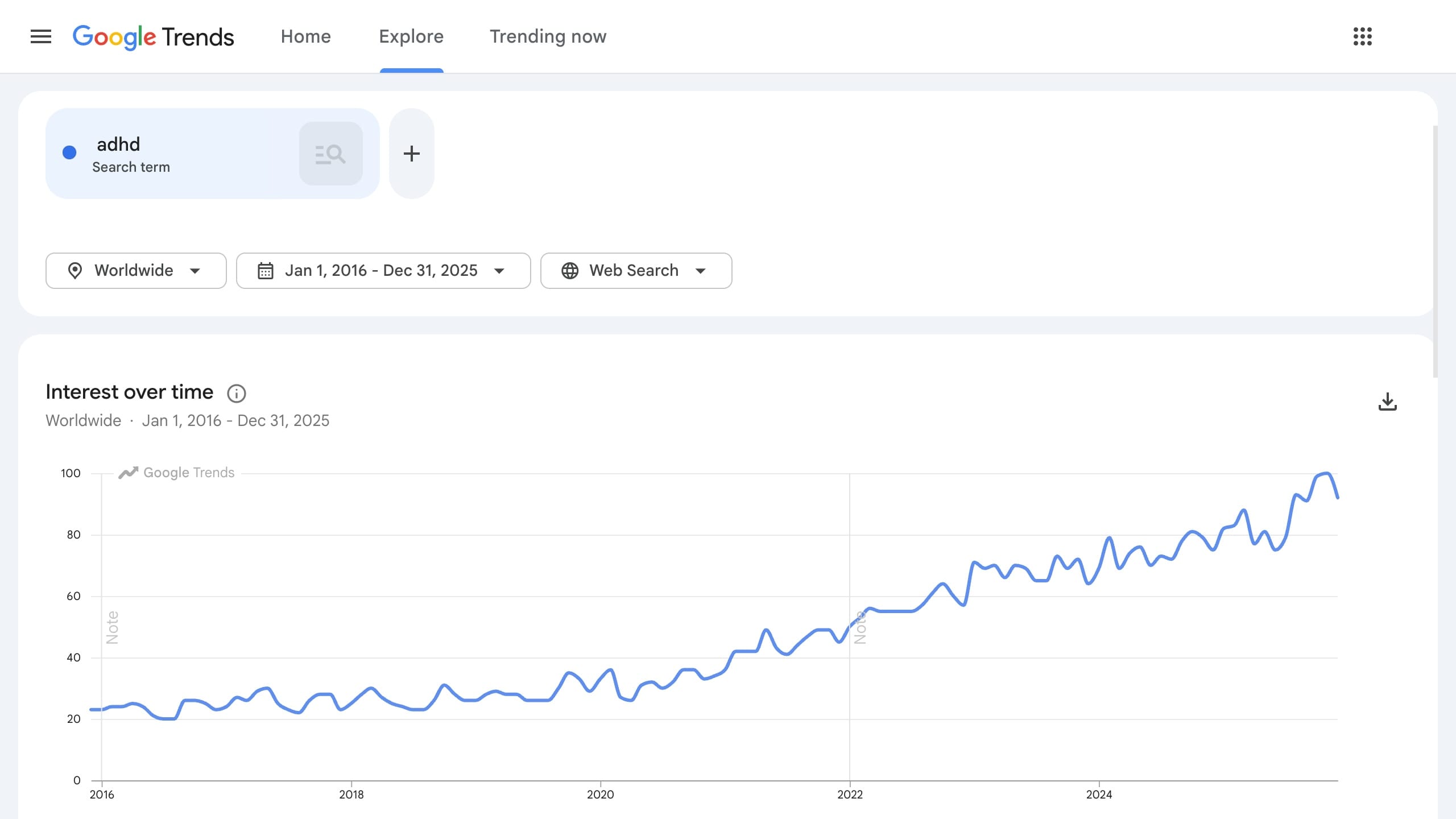
A simple Google Trends search confirmed this wider pattern, showing that worldwide interest in ADHD has increased steadily over the past decade and reached its highest levels in 2025.
So a couple of months ago I came across this huge thread on Reddit asking: “Fellow Autistic/ADHD people of Reddit, what did you think was normal for a long time until you realised it wasn’t?“
Before going further, a note on the word “normal.” It appears in the thread title and throughout the comments, so I have kept it when quoting or directly describing the discussion. However, I would rather avoid using it more broadly. Having ADHD does not make someone abnormal, and describing one type of experience as “normal” can unintentionally suggest that other ways of thinking or processing the world are less valid.
What the thread actually shows is that many people assumed their experiences were universal before discovering that others experienced the same situations differently. Neither experience is more “normal” than the other; one may simply be more common.
I exported the thread and analyzed 1,100 unique comments and replies just to understand which themes and topics appear the most often and how would Redditors describe them in their own language. The discussion was posted on August 26, 2025.
The thread covered much more than familiar clinical terms. Redditors wrote about hearing electrical hums, forgetting objects once they were out of sight, replaying conversations, becoming intensely interested in a topic and then suddenly losing interest, and discovering that some people really can experience a quiet mind. One of the highest rated comments in the entire thread was the following: “Some people, at times, don’t have any songs playing in their head.”
The findings do not represent every person with ADHD or autism, and they should not be treated as prevalence estimates. They describe one large public discussion where Redditors chose to share their own experiences, and their diagnostic status and age could not be independently confirmed. Even with those limits, the thread offers a useful look at how neurodivergent traits can remain unnoticed for years when someone assumes everyone else is dealing with the same internal experience more successfully.
How the comments were analyzed
The downloaded Reddit export contained 1,108 rows. After removing two blank entries and six exact duplicates, 1,100 unique comments and replies remained in the final dataset. The analysis covered both top level comments and replies because many of the most detailed personal experiences appeared deeper in the conversation. Comments were coded using a keyword-based script developed with AI assistance and refined through several rounds of manual review.
Each theme has a written definition and a fixed list of matching patterns, so the entire count can be re-run and checked by anyone with the export and the coding script. The full codebook is summarized in the appendix at the end of this article.
A comment qualified for a theme if it explicitly named the experience or clearly described it in matching everyday language. A Redditor did not need to write “executive dysfunction” to be included in that category, because descriptions such as wanting to start a task and being unable to begin were also captured. The coding was deliberately conservative. Brief conversational replies, jokes, ambiguous descriptions and paraphrases that did not match any documented pattern were left uncoded, which means the counts below are best read as floors rather than exact totals.
| Dataset step | Amount |
|---|---|
| Raw exported rows | 1,108 |
| Blank entries removed | 2 |
| Exact duplicates removed | 6 |
| Unique comments and replies analyzed | 1,100 |
| Comments coded under at least one theme | 564 |
| Comments left uncoded | 536 |
Comments could belong to more than one theme because many experiences overlapped. Someone might describe racing thoughts, poor sleep and problems at work in the same reply, so that comment would be counted under several categories. Coded comments carried 1.5 themes on average, and the percentages below overlap and do not add up to 100%.
Because roughly half the dataset consists of short reactions, follow-up questions and other comments that describe no specific experience, each theme’s share is reported two ways: as a share of all 1,100 comments, and as a share of the 564 comments that described at least one codable experience.
The most common themes in the discussion
The table below shows how often each theme appeared across the 1,100 Reddit comments, including its share of all comments and of the 564 comments that were coded under at least one theme.
| Theme | Comments | Share of all 1,100 | Share of 564 coded |
|---|---|---|---|
| Diagnosis, treatment and medication | 164 | 14.90% | 29.10% |
| Mental noise, inner speech and music | 116 | 10.50% | 20.60% |
| Sensory sensitivity and sensory filtering | 105 | 9.50% | 18.60% |
| Sleep, fatigue and burnout | 94 | 8.50% | 16.70% |
| Work, school and daily functioning | 65 | 5.90% | 11.50% |
| Attention, hyperfocus and changing interests | 52 | 4.70% | 9.20% |
| Memory, object permanence and forgetfulness | 47 | 4.30% | 8.30% |
| Social communication, masking and scripting | 39 | 3.50% | 6.90% |
| Emotional regulation, rejection and criticism | 37 | 3.40% | 6.60% |
| Routine, rigidity and transitions | 34 | 3.10% | 6.00% |
| Executive dysfunction and task initiation | 24 | 2.20% | 4.30% |
| Language, speech and communication quirks | 18 | 1.60% | 3.20% |
| Relationships and interpersonal patterns | 17 | 1.50% | 3.00% |
| Stimming and repetitive behavior | 16 | 1.50% | 2.80% |
| Time perception, lateness and waiting mode | 10 | 0.90% | 1.80% |
These figures describe how often each theme appeared clearly enough to be coded in this specific discussion, not how common the experience is among all people with ADHD or autism. Theme counts also reflect which topics generated long chains of agreement in the thread, since replies often echoed the comment above them.
Diagnosis helped many Redditors reinterpret their past
Diagnosis, treatment and medication formed the largest theme, coded in 164 comments. Many Redditors described diagnosis as the point when earlier parts of their lives finally started to make sense. Problems at school, unstable work patterns, emotional reactions and years of unfinished tasks no longer looked like a random collection of personal failures. One Redditor recalled being diagnosed after a second grade teacher reported that they often took “in-classroom field trips.”
Medication stories were a large part of this theme, and the most striking ones were about quiet. One Redditor wrote, “The first time I took adderall and my brain was quiet,” and described immediately falling asleep. Another recalled a psychiatrist explaining that “people without ADHD can choose what they’re focused on” and being stunned that this was an option.
There was also a clear sense of grief in some replies. Redditors wondered how different school, work or relationships might have been if they had understood themselves earlier or received support before reaching burnout. Diagnosis did not remove every difficulty, but it often replaced a harsh explanation such as “I am lazy” with one that felt more accurate and useful.
Constant mental activity was one of the most recognizable experiences
Mental noise, inner speech and music appeared in 116 comments. Redditors described minds that rarely felt quiet, with constant internal narration, several thoughts happening at once, old conversations replaying and fragments of music repeating for hours or days. The shortest and most upvoted descriptions were also the most vivid. “Not everyone’s thoughts have thoughts,” one Redditor wrote.
Several Redditors had assumed that phrases such as “clear your mind” were simply expressions. Learning that another person could sit quietly without plans, memories, music and random thoughts competing for attention felt almost unbelievable to them.
This tracks with what researchers have found about inner experience more broadly. Sampling studies led by psychologist Russell Hurlburt suggest that inner speech occurs in only about a quarter of randomly sampled moments on average, with enormous individual differences: some people report almost no inner speech at all, while others report it most of the time. What stood out in the thread was not having an inner voice, which many people do, but the persistence and intensity of the activity and how difficult it was to turn down.
Sensory differences affected ordinary environments
Sensory sensitivity and sensory filtering appeared in 105 comments, making it the third largest theme. Redditors described hearing lights, chargers, printers, clocks and background sounds that other people seemed unable to perceive at all. The single most relatable version came from an office: “no one else in my office can hear the fluorescent lights.”
Beyond sound, Redditors mentioned bright lighting, clothing seams, tags, fabrics, strong smells and food textures that could become difficult to tolerate. Several only recognized the difference after someone else failed to notice the same sensation, or after assuming for years that uncomfortable clothing bothered everyone and other people were simply better at ignoring it.
The issue was not always having stronger senses. Often it was the difficulty of filtering sensations into the background once they had been noticed. “Sharp noises can cause me physical pain in my head,” one Redditor wrote, adding that the sound did not even need to be loud. A small noise, texture or light could remain impossible to ignore, which meant an ordinary office, classroom or shop could feel crowded with discomfort even when everyone else seemed relaxed.
Sleep problems were connected to more than bedtime
Sleep, fatigue and burnout appeared in 94 comments. Redditors wrote about lying awake for hours with an active mind, delaying bedtime despite exhaustion, waking without feeling rested and needing hours to feel functional in the morning. Some said they read to fall asleep their entire lives because it was the only way to hand their thoughts to another storyline.
The comments also showed how sleep difficulties connected with other themes. A Redditor might describe racing thoughts that grew louder at bedtime when nothing else was there to distract from them, then struggle to wake for work the next morning. What looked like one sleep problem was often part of a larger pattern involving attention, stress and mental noise.
Burnout appeared in several forms as well. Some Redditors described exhaustion after social situations, while others felt worn down by work, sensory overload or the effort of appearing organized and calm. This helps explain why advice such as “just go to bed earlier” can feel too simple when the bedtime problem is only one part of what is happening.
Work and school difficulties were often inconsistent
Work, school and daily functioning appeared in 65 comments. Redditors described doing very well in subjects they enjoyed while struggling to complete basic assignments elsewhere, producing excellent work under pressure but finding routine tasks almost impossible to start, and moving between jobs or failing to keep them before diagnosis. The very first comment in the thread described believing a stable job would never be possible, then holding one for two years after diagnosis and medication.
This inconsistency was often misunderstood by teachers, managers and family members. When someone performs well once, other people may assume they can repeat that performance whenever they choose. If they cannot, the difference gets read as carelessness or lack of effort rather than a genuine difficulty with attention, structure or task initiation. Many Redditors described feeling capable but unreliable because their performance changed with interest, urgency, energy and environment, and that gap between ability and consistency caused real frustration.
Hyperfocus and changing interests were both common
Attention, hyperfocus and changing interests appeared in 52 comments. Redditors described becoming deeply absorbed in hobbies, games, artists or research topics, then losing the interest as abruptly as it arrived. One of the thread’s most upvoted comments described being “addicted to a song/actor or artist/show” and then losing interest “immediately on the 14th day.” These intense interests may be reinforced by novelty and quick rewards, which activate the brain’s reward system and make a new activity feel especially compelling at first.
Hyperfocus was not always described as a problem. It could feel exciting, productive and satisfying, especially when directed toward something meaningful. The difficult part was that people could not choose where their attention went or how long the interest would last. A Redditor might spend an entire day on a personal interest while struggling to concentrate for ten minutes on an obligation, and something central to their life one week could feel irrelevant the next, leaving behind unfinished projects and unused supplies.
Memory problems went beyond ordinary forgetfulness
Memory, object permanence and forgetfulness appeared in 47 comments. Redditors described losing everyday items, forgetting why they had entered a room and failing to remember tasks unless they were directly visible. Different versions of “out of sight, out of mind” ran throughout the thread, including one Redditor who put a coat in the laundry, forgot the laundry existed and spent two weeks with a nagging feeling that the coat rack looked wrong.
Some forgot to answer messages even when they cared deeply about the person. Others could not hold onto names, birthdays or shopping lists at all, or said they remember things “but never when I’m supposed to.” These situations created practical problems and could also strain relationships when forgetfulness was interpreted as disinterest.
The comments suggested that reminders, visible lists, calendars and alarms were not signs of laziness or overdependence. They were practical ways to support memory that did not work reliably on its own. For many Redditors, building an external system was less about discipline and more about making important information harder to lose.
Social interaction could involve constant calculation
Social communication, masking and scripting appeared in 39 comments, but they included some of the most upvoted material in the thread. The second most upvoted comment overall described strictly following social norms and being agitated when others broke them, before discovering that “most people aren’t reciting and following a made up rule book in their heads.”
Redditors described socializing as something learned through observation rather than intuition. They watched how other people behaved, mimicked facial expressions and mannerisms, rehearsed conversations in advance and stored scripts from past interactions for later use. Some consciously managed eye contact or borrowed parts of their personality from friends, public figures or fictional characters because this gave them a clearer model for how to behave.
From the outside, this could look like confidence or strong social skills. Internally, it could feel like performing while monitoring tone, timing, facial expression and body language at the same time. Several Redditors also described the frustration of learning social rules carefully, only to find that other people applied those rules inconsistently.
Emotional reactions were often followed by shame
Emotional regulation, rejection and criticism appeared in 37 comments. Redditors described taking criticism deeply, relentless self criticism, replaying embarrassing moments, quick tempers they worked hard to control and an overinflated sense of justice that flared at every unfairness. Many had spent years calling themselves dramatic, immature or too sensitive.
The reaction often felt automatic even when the person understood the situation was minor. Someone might know a comment was not a personal attack but still feel unable to stop thinking about it. These experiences are not unique to ADHD or autism and can have many causes. What stood out in the thread was how often Redditors treated the reaction as proof that something was wrong with their personality. Understanding the pattern did not remove the emotion, but it sometimes reduced the shame attached to it.
Smaller themes still affected everyday life
Six themes appeared less often but still covered important parts of daily life.
Routine, rigidity and transitions (34 comments) covered reliance on familiar foods, repeated schedules and specific ways of doing everyday things. For some, routine was comforting because it reduced decisions and surprises, and a change in plans could affect mood or concentration for far longer than seemed reasonable from outside. Stopping one absorbing activity to start another could take more effort than either task itself.
Executive dysfunction and task initiation (24 comments) was different from deciding not to do something. Redditors described wanting to start a task and feeling unable to move toward it, relying on deadline panic to finally act, and starting many projects while finishing few. This difficulty starting a task can sometimes feel like a complete loss of motivation, even when the person genuinely wants to act. One Redditor remembered being stunned in high school to learn that other people can simply decide to do something and immediately do it. Before learning the term, many had settled on “lazy,” a label that added shame without explaining anything.
Language, speech and communication quirks (18 comments) included interrupting, talking at length about a topic of excitement, struggling to find words, planning sentences while speaking and being told they were too blunt or direct. These patterns could be mistaken for rudeness when the reality was usually a person trying hard to connect while managing excitement, working memory and the pressure to respond quickly.
Relationships and interpersonal patterns (17 comments) included the single most upvoted comment in the entire thread, which described chaotic romantic relationships driven by passion followed by abruptly losing all interest. Others described becoming best friends with someone for weeks and then disappearing, not because feelings changed but because attention did.
Stimming and repetitive behavior (16 comments) covered leg bouncing, pacing, fidgeting, doodling to concentrate, and chewing lips or cheeks. Some Redditors had not recognized these as self regulation because they had been doing them automatically for years, and several only noticed after another person pointed it out or complained.
Time perception, lateness and waiting mode was the smallest theme, coded in just 10 comments. The clearest examples described having no reliable sense of how much time had passed, checking the clock constantly to compensate and being late despite planning. A few comments touched on being unable to use the hours before an appointment. Although time blindness is one of the most discussed ADHD traits online, it was barely present in this particular thread, a useful reminder that any single discussion reflects what its participants happened to raise, not the full picture of a condition.
The most relatable comments were specific
The highest rated comments were not filled with technical language. Redditors talked about hearing lights, songs that never stop playing, thoughts that have thoughts and an invisible rule book for social situations. Those direct descriptions made invisible experiences easier for other people to recognize.
“Sensory filtering difficulty” is useful language, but hearing the office lights gives the reader an immediate picture. “Executive dysfunction” is an important term, but discovering that other people can decide to do something and simply begin explains the experience in a way that feels concrete. People often recognize themselves in a specific example before they recognize themselves in a formal definition, which is one reason lived experience discussions can be so useful when handled carefully.
What the findings do and do not show
This analysis describes one public Reddit discussion and does not show how common these experiences are among all adults with ADHD or autism. Several limits matter when reading the numbers.
The Redditors were self selected, their diagnostic status could not be confirmed, and Reddit users do not represent the general population. Ages were also not verifiable, so although the discussion reads as an adult conversation about jobs, marriages and late diagnoses, “adults” is an assumption based on content rather than a verified fact.
The percentages refer only to this dataset. Saying that 116 comments mentioned mental noise means exactly that, not that a certain share of all people with ADHD or autism experience it. The export also flattened the thread structure, and replies frequently echoed the comment above them, so theme counts partly reflect which topics generated long chains of agreement rather than fully independent reports.
Finally, the coding itself is conservative by design. It relies on documented patterns plus manual review, and it will miss experiences described in unusual wording while occasionally including borderline mentions. Comments could belong to several themes at once. The figures are a structured, reproducible overview of one discussion, not clinical prevalence estimates.
Why these stories matter
For me, the most interesting part of this Reddit discussion was not any single theme. It was the fact that many people spend years believing that their challenges and difficulties reflected something unusual about their own character.
Again, back to my friend. I’ve heard her stories from early childhood: getting punished at school for fidgeting in her chair or clicking her pencil until the teacher called her mother to say she was distracting classmates. She also struggled in social settings, but she did not realize that these experiences might be different from what other people were going through. She assumed that everyone found these situations difficult and that she was simply worse at managing them.
I noticed the same pattern throughout the Reddit comments. Many Redditors had believed that everyone’s mind was equally loud, that everyone struggled to understand certain social rules or that everyone felt just as overwhelmed by uncomfortable sounds, textures and sensations. Because they assumed these experiences were universal, they often concluded that other people simply had more discipline, better social skills or greater self-control.
Realizing that these experiences are not universal can be unsettling. At the same time, it can also bring relief because clearer language can make it easier to understand your feelings and recognize why certain situations affect you so strongly. Instead of thinking, “I am lazy,” someone may begin to understand that wanting to start a task and being able to start it are not always the same thing.
That realization does not provide a diagnosis, and online discussions should never be treated as a substitute for a professional assessment. However, they can help people recognize patterns, describe their difficulties more clearly and approach their experiences with greater curiosity and less shame.
Appendix: coding definitions
A comment was coded under a theme if it explicitly named the experience or clearly described it in matching language. The full pattern lists and coding script are available on request.
| Theme | A comment qualified if it described… |
| Diagnosis, treatment and medication | Being diagnosed, assessed or undiagnosed; medication for ADHD or autism and its effects |
| Mental noise, inner speech and music | Constant internal narration, racing or simultaneous thoughts, songs playing internally, replayed conversations, inability to have a quiet mind |
| Sensory sensitivity and filtering | Aversive or unusually acute response to sounds, light, textures, tags, fabrics, smells or food; hearing hums others cannot; inability to filter background sensation |
| Sleep, fatigue and burnout | Trouble falling asleep or waking, bedtime procrastination, unrefreshing sleep, exhaustion, burnout |
| Work, school and daily functioning | School or job performance, keeping jobs, grades, homework, inconsistent achievement |
| Attention, hyperfocus and changing interests | Hyperfocus, intense interests that fade abruptly, cycling hobbies, distractibility |
| Memory, object permanence and forgetfulness | Forgetting items, tasks, messages or appointments; out of sight out of mind; reliance on reminders |
| Social communication, masking and scripting | Learning social behavior by observation, mimicking, rehearsing conversations, managing eye contact, masking |
| Emotional regulation, rejection and criticism | Rejection sensitivity, harsh self criticism, intense emotions, replayed embarrassments, temper, sense of justice |
| Routine, rigidity and transitions | Reliance on sameness, distress at changed plans, difficulty switching between activities |
| Executive dysfunction and task initiation | Wanting to start a task but being unable to begin; deadline dependence; unfinished projects |
| Language, speech and communication quirks | Interrupting, oversharing, word finding difficulty, bluntness, preferring writing to speech |
| Relationships and interpersonal patterns | Intense then fading romantic interest, friendship maintenance difficulty, people pleasing, ghosting |
| Stimming and repetitive behavior | Fidgeting, rocking, pacing, leg bouncing, chewing, doodling or moving to regulate |
| Time perception, lateness and waiting mode | No reliable sense of elapsed time, chronic lateness despite planning, waiting mode before appointments |