Key takeaways
- Brain plasticity means the brain can change, adapt, and reorganize through learning, practice, experience, stress, or injury.
- Repeated thoughts, skills, habits, and behaviors can strengthen brain pathways, while unused pathways can become weaker over time.
- Brain plasticity helps explain how people learn new skills, form habits, recover after some injuries, and build new emotional responses.
- Plasticity does not mean change is instant or unlimited. The brain usually changes through repetition, consistency, sleep, movement, support, and time.
- Adults still have brain plasticity, although change can be slower than in childhood.
Intro
Brain plasticity is the brain’s ability to change, adapt, and reorganize itself.
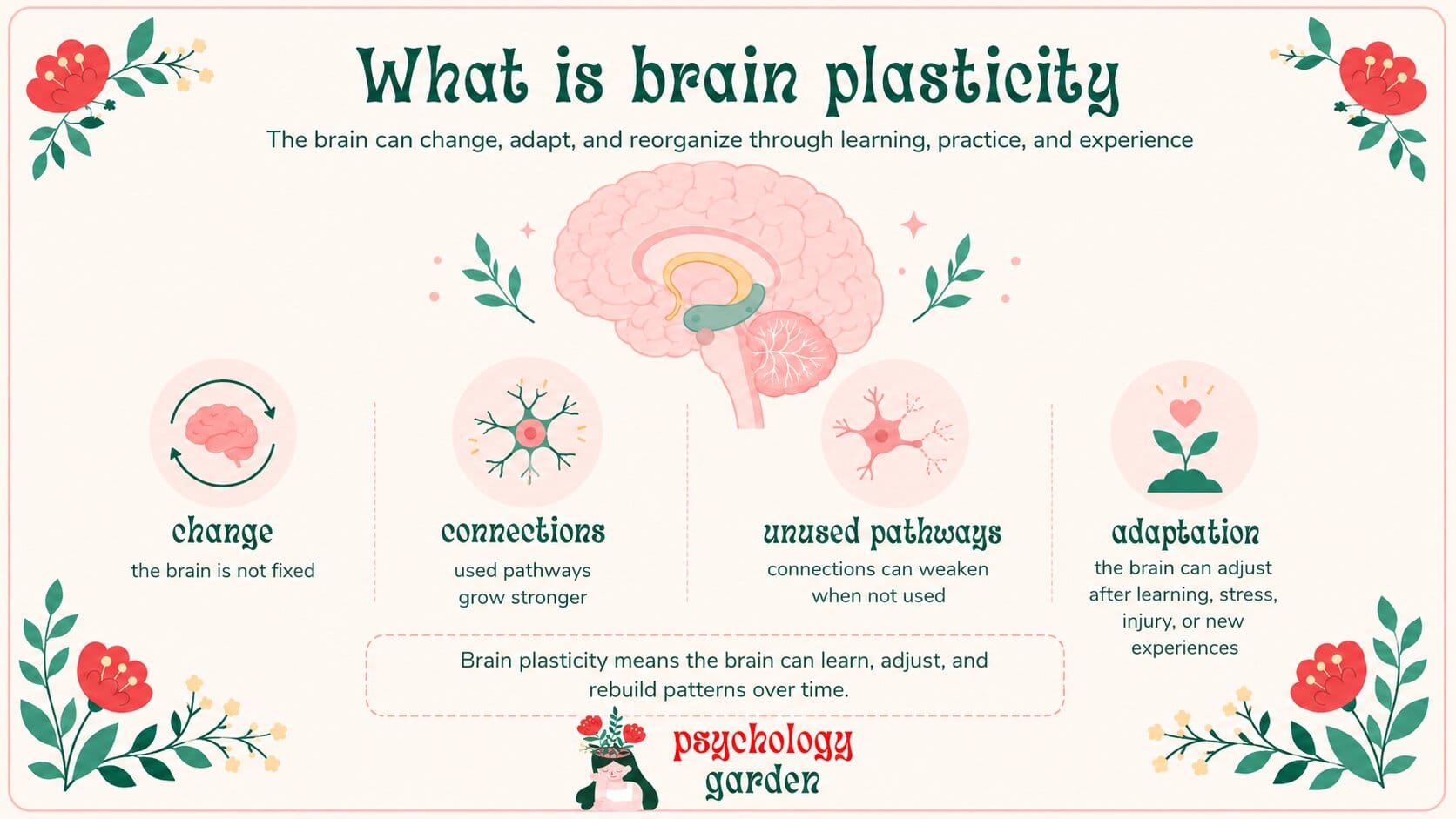
It means the brain is not fixed. It can build stronger connections, weaken unused ones, and adjust after learning, practice, stress, injury, or new experiences.
A simple way to picture it is like a path in a garden. The more often you walk the same path, the clearer it becomes. If you stop using it, it slowly becomes less visible. The brain works in a similar way. When you repeat a thought, skill, habit, or behavior, the brain can make that pathway easier to use again.
This does not mean the brain can change instantly or completely. But it does mean that learning, repetition, and environment can shape how the brain works over time.
What is brain plasticity?
Brain plasticity, also called neuroplasticity, is the nervous system’s ability to change.
These changes can happen in different ways. Neurons can strengthen their connections. Some connections can become weaker. Brain areas can become more active with practice. In some cases, the brain can also reorganize after damage, so other areas help support part of a lost function.
This is why the brain can learn new skills, remember information, recover after certain injuries, and adapt to new situations.
For example, when you learn a new language, practice piano, start psychotherapy, exercise regularly, or change a habit, your brain is not just “thinking differently.” It may also be changing how certain networks communicate.
How brain plasticity works
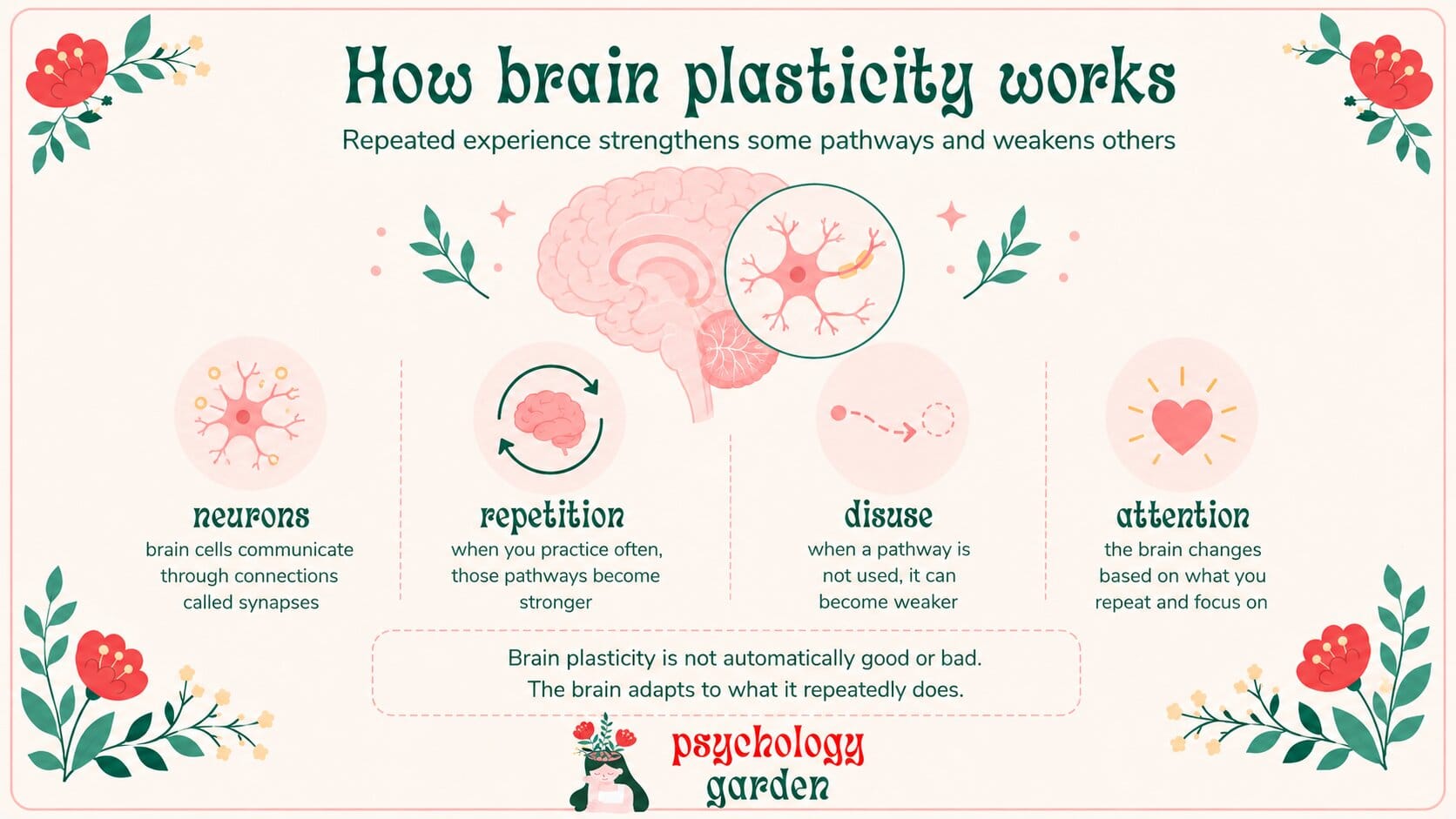
The brain is made of billions of nerve cells called neurons. Neurons communicate through connections called synapses.
The brain is made of billions of nerve cells called neurons. Neurons communicate at connections called synapses, where signals pass from one cell to another.
When you repeat something often, the connections involved in that action or thought can become stronger. This is one reason practice matters. The brain starts to treat repeated patterns as familiar.
This can be helpful. It allows you to learn, improve, and remember.
But it can also work in the opposite direction. If the brain repeats stress, fear, avoidance, or negative thinking for a long time, those patterns can also become easier to fall into.
Repetition can also play a role in obsessive patterns. For example, repeatedly checking an uncertain memory may bring brief relief, but it can also keep the doubt alive and make the person trust their memory less over time.
That is why brain plasticity is not automatically good or bad. It simply means the brain changes based on what it repeatedly does, experiences, and pays attention to.
This is also connected to the the brain’s reward system because the brain tends to repeat behaviors that feel rewarding, familiar, or emotionally important.
A simple example of brain plasticity
Think about learning to drive.
At first, everything feels hard. You need to think about the wheel, mirrors, pedals, road signs, speed, and other cars at the same time.
After enough practice, driving feels more automatic. Your brain has become better at coordinating the movements, attention, and decisions needed for that skill.
The same thing can happen with emotional patterns.
If someone has learned to avoid conflict, their brain may quickly move toward silence, tension, or withdrawal when something feels uncomfortable. If they slowly practice speaking up in safe ways, the brain can begin to learn a new response. These small changes can also make it easier to recognize emotional reactions as they happen.
This is not magic. It is repetition, attention, and experience changing the brain over time.
What research shows about brain plasticity
Brain plasticity is not just a nice idea. Researchers have measured real changes in the brain after learning and practice.
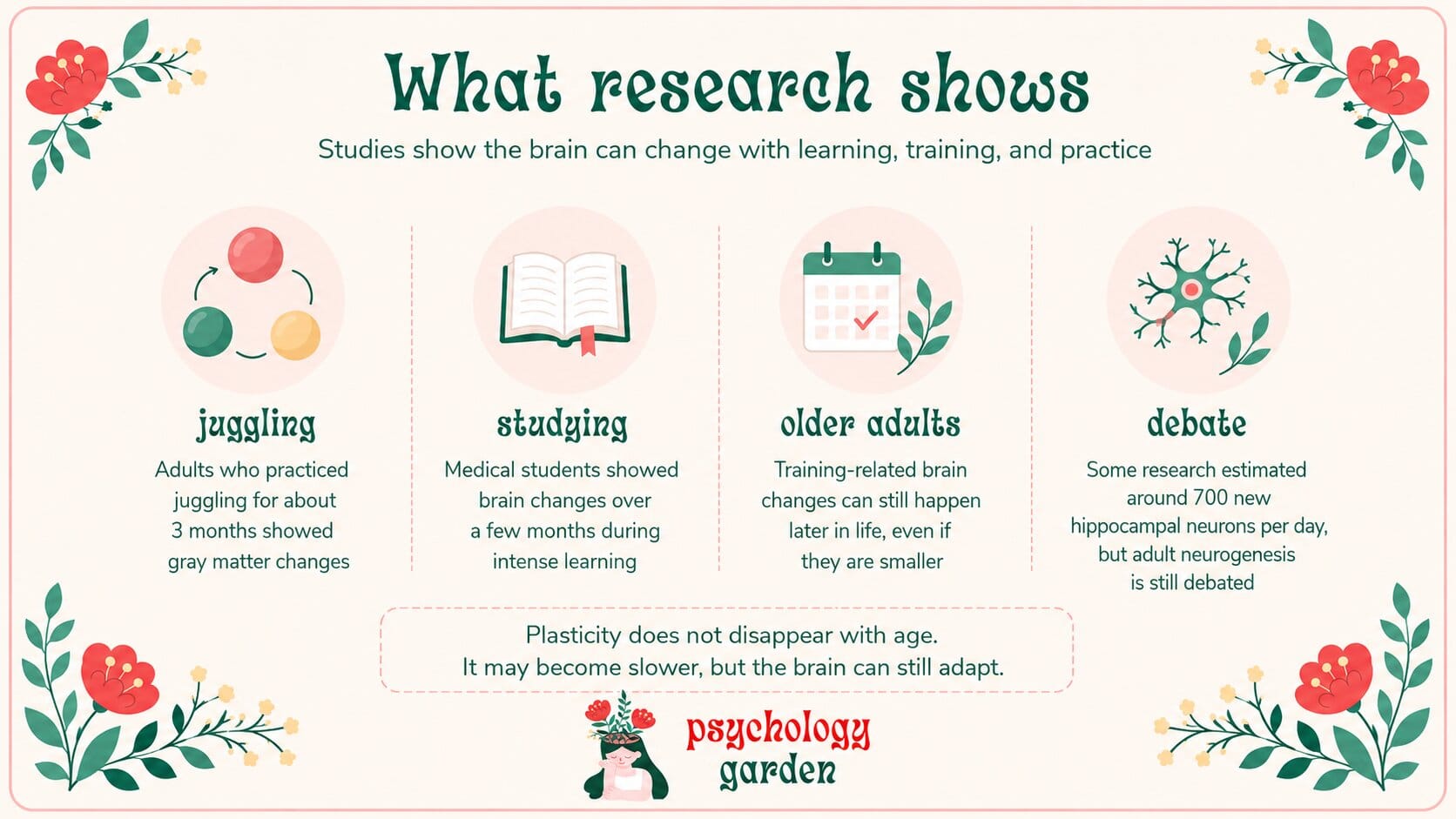
One well-known study found that adults who learned to juggle showed changes in gray matter in brain areas linked to visual motion after about 3 months of training. When they stopped practicing, some of those changes became smaller again. This suggests that the brain can change with training, but also adapt when a skill is no longer used.
Another study looked at medical students during a period of intense studying. Researchers found brain structure changes over a few months, especially in areas linked to learning and memory. This supports the idea that mental effort and repeated learning can also shape the brain, not only physical skills.
Research has also found that older adults can still show training-related brain changes. In one juggling study with older adults, the brain still changed after practice, although the changes were smaller than what is often seen in younger people. This means plasticity does not disappear with age, but it may become slower or less flexible.
Adult neurogenesis, or the birth of new neurons in the adult brain, is more debated. One 2013 study estimated that adults may add around 700 new neurons per day in the hippocampus, a brain area involved in memory. But newer research has questioned how much this really happens in adult humans, so it is better to describe this as an active scientific debate, not a settled fact.
Why brain plasticity matters
Brain plasticity matters because it shows that change is possible.
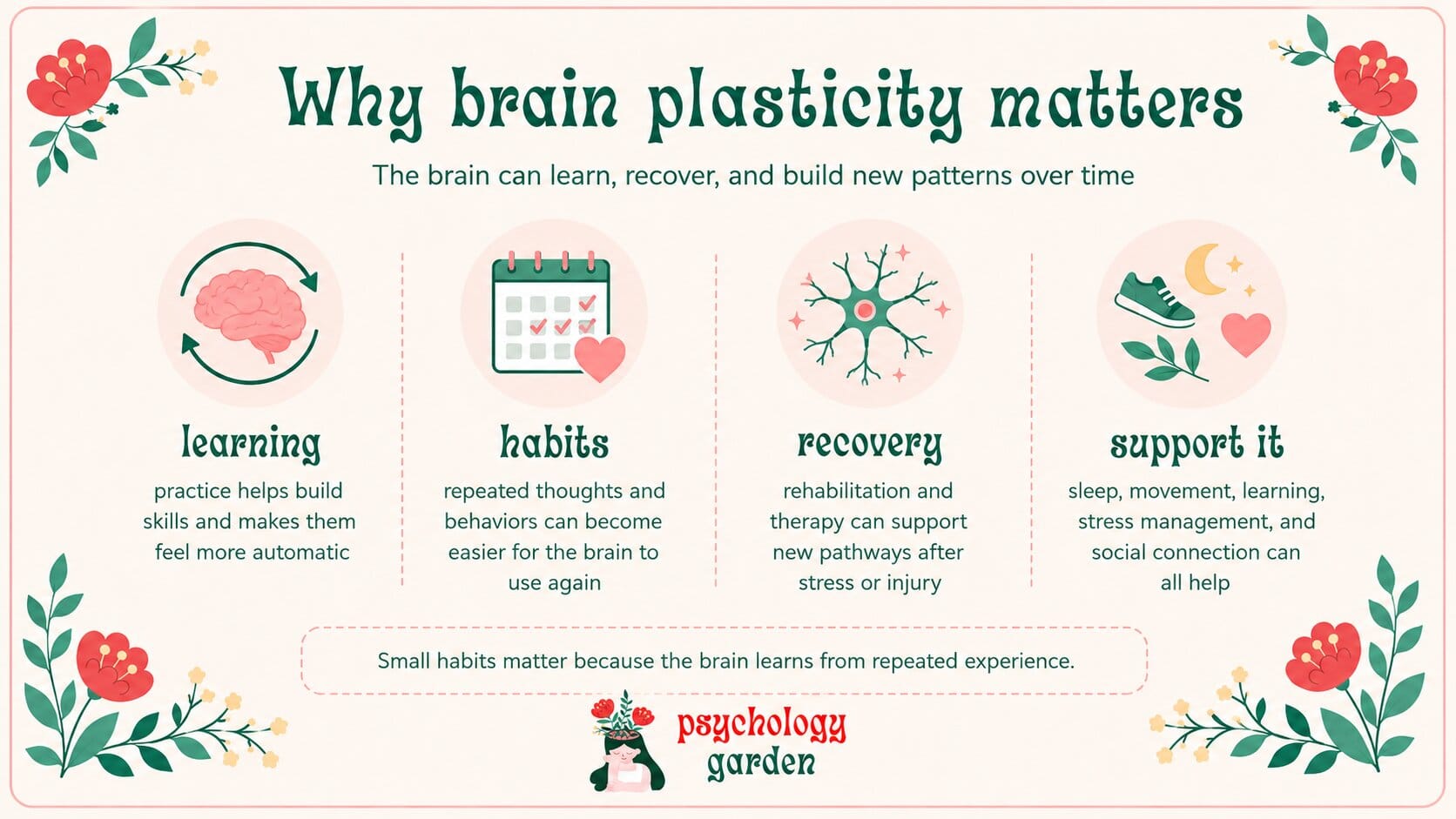
It helps explain why practice improves skills, why habits become automatic, why therapy can help people build new emotional responses, and why rehabilitation can support recovery after brain injury or stroke.
It also helps explain why the brain can get stuck in certain patterns. If a person repeats the same reaction many times, the brain may start using that reaction quickly, even when it is no longer helpful. In one analysis of ADHD and autism experiences, many Redditors described interpreting recurring patterns of attention, emotion and behavior as personal failings before they had clearer language for them.
For example, someone who has been anxious for a long time may not be “choosing” to overthink. Their brain may have learned to scan for danger very quickly. But with the right support and repeated practice, the brain can also learn calmer and more flexible responses.
Brain plasticity also connects to well-being, because repeated stress, social connection, and daily emotional patterns can shape how people feel over time. This is also reflected in broader research on the global happiness report.
Can you improve brain plasticity?
You cannot control brain plasticity completely, but you can support it.
Learning something new, practicing regularly, sleeping enough, moving your body, managing stress, and staying socially connected can all support the brain’s ability to adapt.
The important part is consistency. The brain usually changes through repeated experience, not one perfect moment.
This is why small habits matter. Reading a little every day, practicing a skill, going for walks, doing therapy exercises, or changing one response at a time can all become signals to the brain.
Over time, the brain learns from what you repeat.
Final thoughts
Brain plasticity means the brain can change.
It does not mean change is always easy, fast, or unlimited. But it does mean the brain is more flexible than people used to believe.
Every repeated thought, habit, skill, and experience can leave a mark. Some patterns become stronger because we use them often. Others become weaker when we stop feeding them.
That is what makes brain plasticity so important. It reminds us that the brain is not frozen in one version of itself. It can learn, adjust, and rebuild patterns over time.
FAQs
Brain plasticity is the brain’s ability to change and adapt. It means the brain can strengthen useful connections, weaken unused ones, and reorganize itself through learning, practice, and experience.
Yes. Adults can still show brain plasticity. Research has found brain changes after learning, training, and practice in adults, and even in older adults. The changes may be slower than in childhood, but they can still happen.
It depends on the person, the skill, and the type of change. Some studies have found measurable brain changes after around 3 months of training or intense learning. But emotional and behavioral change often needs repeated practice over time.
Sources
- Nature – Neuroplasticity: Changes in grey matter induced by training
- The Journal of Neuroscience – Temporal and Spatial Dynamics of Brain Structure Changes During Extensive Learning
- The Journal of Neuroscience – Training-Induced Brain Structure Changes in the Elderly
- Cell – Dynamics of Hippocampal Neurogenesis in Adult Humans