Intro
You know what needs to be done and may genuinely care about the consequences, yet starting still feels unusually difficult. Even basic tasks such as answering a message, taking a shower or putting away laundry can feel heavier than they should.
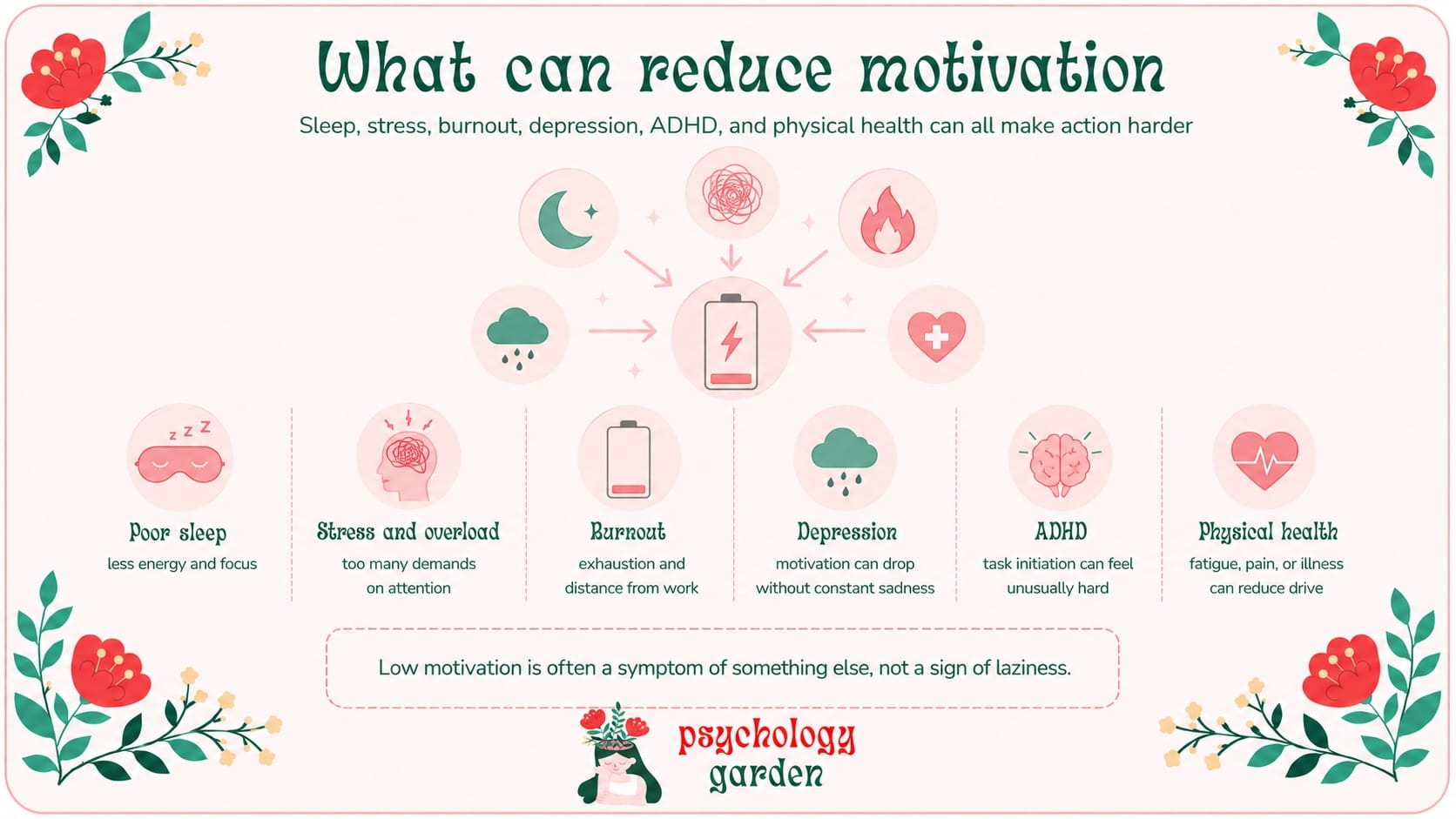
Having no motivation does not automatically mean you are lazy. Motivation can drop because of exhaustion, chronic stress, burnout, depression, ADHD-related task initiation difficulties, physical health conditions or medication effects. The most useful question is not, “What is wrong with me?” but, “What is making action difficult right now?”
Key takeaways
- Low motivation is often a symptom of another problem, not a character flaw.
- Tiredness, apathy and loss of pleasure can all feel like low motivation, but they are different experiences.
- Poor sleep, stress, burnout, depression, ADHD and physical health issues can reduce motivation.
- Making a task smaller and easier to begin is often more effective than waiting to feel ready.
- Professional support may be needed when low motivation persists or disrupts everyday life.
What does having no motivation actually mean?
Having no motivation means that starting or continuing a goal-directed activity feels harder than usual. You may understand why something matters and still feel little drive to act on that knowledge.
However, “no motivation” can describe several different experiences. You may want to complete a task but feel physically exhausted, have enough energy but feel unable to begin, or find that activities you once enjoyed no longer feel rewarding. Some people struggle mainly with routine responsibilities, while others lose interest in almost every area of life.
The pattern can offer clues about the cause. If you can focus for hours on an interesting activity but cannot begin a basic administrative task, the problem may involve attention or task initiation. If nothing feels enjoyable anymore, depression or anhedonia may be more relevant. If you still want to act but feel constantly drained, sleep, stress or physical health may need more attention.
Motivation does not come from one chemical or one part of the brain. It depends on systems involved in attention, memory, emotion, decision-making, effort and the brain reward system. When a task feels unclear, unrewarding or too distant from its outcome, the effort required to begin may feel greater than the expected reward.
A 2025 study that tracked 155 adults across 3,344 daily assessments found that motivation naturally fluctuated over time. When participants felt more motivated, rewards appeared more valuable and they were more willing to exert effort later.
What is the difference between tiredness, apathy and anhedonia?
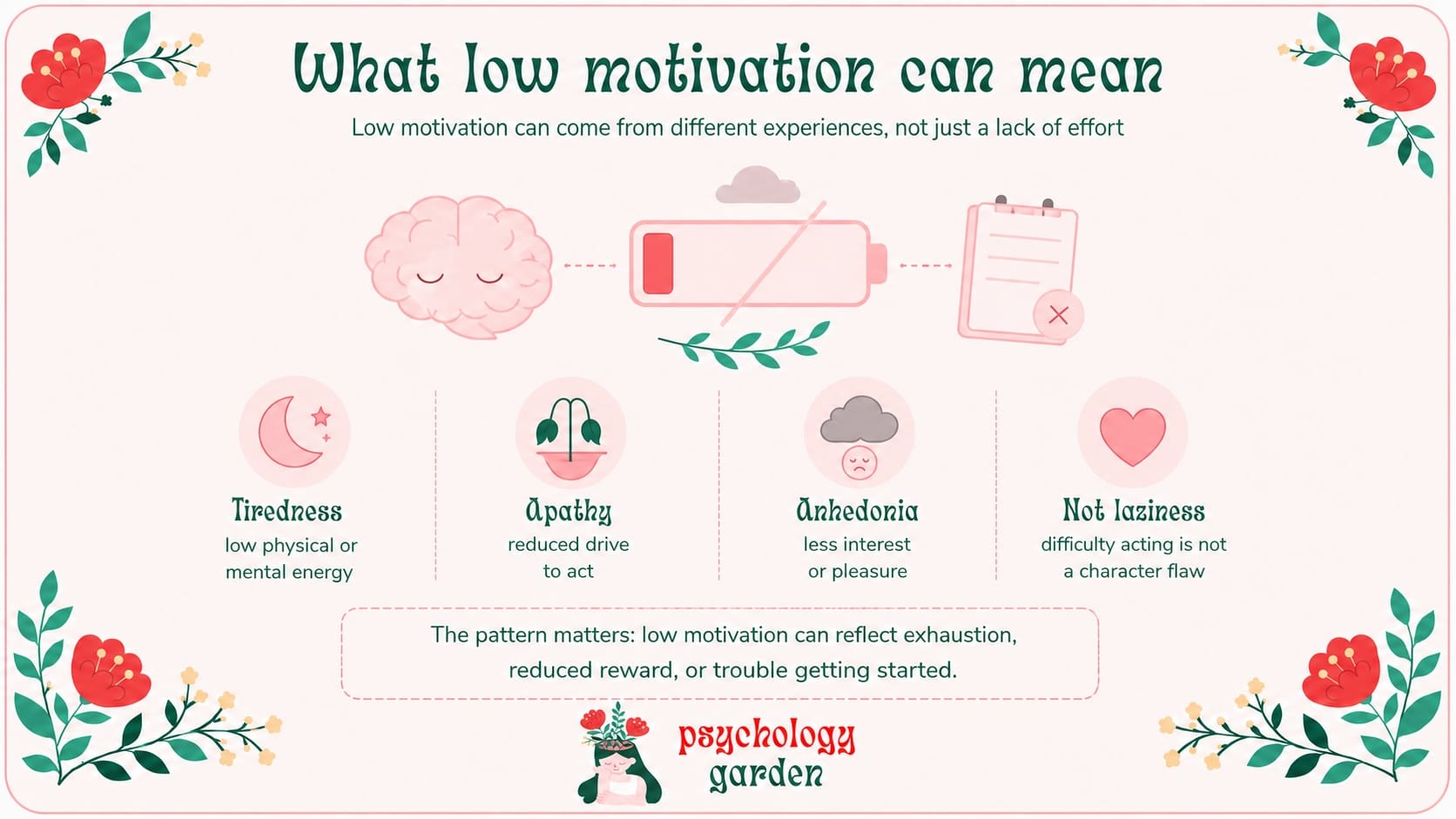
Tiredness, apathy and anhedonia can all feel like a lack of motivation, but they describe different problems. Knowing which one best matches your experience can help you understand what kind of support may be useful.
- Tiredness is a lack of physical or mental energy. You may still care about a task and want to complete it, but feel too drained to begin. Poor sleep, illness, prolonged stress, chronic pain, nutritional deficiencies and medication effects can all contribute.
- Apathy is a reduction in goal-directed motivation and activity. You may know that something is important but feel little internal drive to act. It is not simply a decision to avoid effort.
- Anhedonia means reduced interest or pleasure. Activities that once felt enjoyable, comforting or meaningful may begin to feel flat. Anhedonia is commonly associated with depression, although it can also occur in other mental and physical health conditions.
These experiences can overlap. Persistent tiredness may cause you to withdraw from activities, and repeated withdrawal may make life feel less rewarding. Guilt about inactivity can then add another obstacle, making tasks feel even harder to approach. In some cases, guilt can also become tied to obsessive doubt about the past.
Does having no motivation mean you are lazy?
Having no motivation does not prove that you are lazy. “Lazy” is an informal judgment that does not explain why action has become difficult.
A person may appear inactive while using considerable effort to manage fatigue, anxiety, pain, distraction or emotional overload. The task itself may also be too large or vague. “Clean the apartment” sounds like one instruction, but it involves deciding where to start, what to move, what to throw away and when to stop.
Instead of judging yourself, notice what happens at the moment you disengage. You may feel confused about the first step, convinced that the task will take too long, afraid of doing it badly or bored because the reward feels too distant. You may also realize that you simply do not have enough energy.
Identifying the obstacle gives you something practical to change. Self-criticism usually adds stress without making the task clearer, smaller or easier to begin.
Can poor sleep, stress and overload reduce motivation?
Poor sleep, chronic stress and overload can reduce motivation because they leave fewer mental resources for attention, planning and self-control. When your capacity is already stretched, ordinary tasks can begin to feel disproportionately demanding.
Sleep deprivation can cause fatigue, irritability, slower thinking and difficulty concentrating. It may also make effort feel more costly, especially when a task is repetitive or offers no immediate reward. You might still complete urgent work while ignoring messages, appointments, exercise or household tasks because your brain is prioritizing whatever feels most immediate.
Chronic stress can create a similar pattern. Deadlines, conflict, financial pressure, caregiving and uncertainty all compete for attention. Even when you are not actively thinking about these problems, they can leave less capacity for routine responsibilities and long-term goals.
A study of 90 university students found that high levels of chronic stress were associated with lower motivation to exert effort for a potential reward compared with moderate stress levels. This suggests that prolonged stress may affect not only energy and concentration, but also whether an effort feels worth making.
Trying harder does not always solve overload. Sometimes the real problem is the total number of demands, not a lack of discipline. Reducing responsibilities, clarifying priorities or getting proper rest may be more useful than adding another productivity system.
Can burnout make you lose motivation?
Burnout can severely reduce motivation, particularly in relation to work. The World Health Organization describes burnout as an occupational phenomenon caused by chronic workplace stress that has not been successfully managed.
Burnout typically involves exhaustion, growing mental distance or cynicism toward work and reduced professional effectiveness. You may struggle to start the day, feel detached from responsibilities that once mattered or need far longer than usual to recover after ordinary demands.
Burnout often affects one main role, while depression tends to spread across more areas of life. A person experiencing burnout may still enjoy friends, hobbies or time away from work. Someone with depression may lose interest in those areas as well. However, the two can overlap, and prolonged burnout can affect mental health more broadly.
Time away may provide temporary relief, but burnout is unlikely to improve fully when the same workload, conflict, lack of control or unrealistic expectations remain unchanged. Recovery often requires changes to the source of the problem, not only better coping outside work.
Can depression cause low motivation without constant sadness?
Depression can cause low motivation even when you do not feel obviously sad. Some people mainly experience numbness, irritability, exhaustion, reduced concentration or the sense that nothing feels rewarding.
Look for changes from your normal pattern. You may stop replying to people, neglect personal care, lose interest in hobbies or find that plans you would normally enjoy now feel like obligations. Tasks may become difficult not only because you lack energy, but because completing them no longer seems meaningful.
Depression becomes more important to consider when several symptoms persist for much of the day, nearly every day, for at least two weeks and interfere with daily functioning. However, only a qualified healthcare professional can determine whether your symptoms meet the criteria for a depressive disorder.
Naming your emotions more precisely can make patterns easier to notice. Sadness, numbness, anxiety, frustration and exhaustion may all be described as feeling “bad,” even though they are not identical. Learning more about understanding what you feel may help you describe what has changed.
Can ADHD make it difficult to start tasks?
ADHD can make tasks difficult to start because it affects executive functions such as planning, working memory, attention regulation and task initiation. You may fully intend to do something but struggle to turn that intention into action.
Tasks that are urgent, new or personally interesting may be much easier to begin than tasks that are routine, vague or linked to a distant reward. You might spend hours focused on a new interest but avoid a three-minute email for several days. This inconsistency can be confusing because it may look as though motivation appears only when you choose.
From the outside, the pattern can resemble carelessness or a lack of effort. Internally, it may feel like hitting an invisible wall between knowing what to do and actually beginning. This gap between wanting to start a task and being able to begin was also described by adults with ADHD and autism in an analysis of 1,100 Reddit comments. Making the task more urgent, specific or stimulating may temporarily reduce that barrier.
Occasional procrastination does not automatically indicate ADHD. ADHD involves a persistent pattern that usually begins earlier in life, appears across more than one setting and interferes with everyday functioning. If task initiation has been a long-term difficulty, a professional assessment may be more useful than repeatedly trying stricter routines.
Can physical health conditions affect motivation?
Physical health conditions can affect motivation by causing fatigue, weakness, brain fog, slowed thinking or mood changes. When the body has less energy available, psychological effort can also become harder.
An underactive thyroid may cause tiredness, concentration difficulties and low mood. Iron-deficiency anemia can lead to fatigue, weakness and reduced energy. Sleep disorders, chronic pain, infections, nutritional deficiencies and other medical conditions may produce similar symptoms.
Some medications can also affect alertness, energy or emotional intensity. The timing of the change can provide useful information. Consider whether your motivation dropped after starting medication, changing a dose, becoming ill or developing new physical symptoms.
A primary care appointment may be appropriate when low motivation appears with persistent fatigue, dizziness, weakness, pain, major sleep problems, unexplained weight changes or other physical changes. Do not stop prescribed medication suddenly without medical advice. Discuss possible side effects with the professional who prescribed it.
What should you do when you have no motivation?
When you have no motivation, make action easier instead of demanding that you suddenly feel different. Waiting until you feel completely ready can keep you stuck because motivation often increases only after an activity has begun.
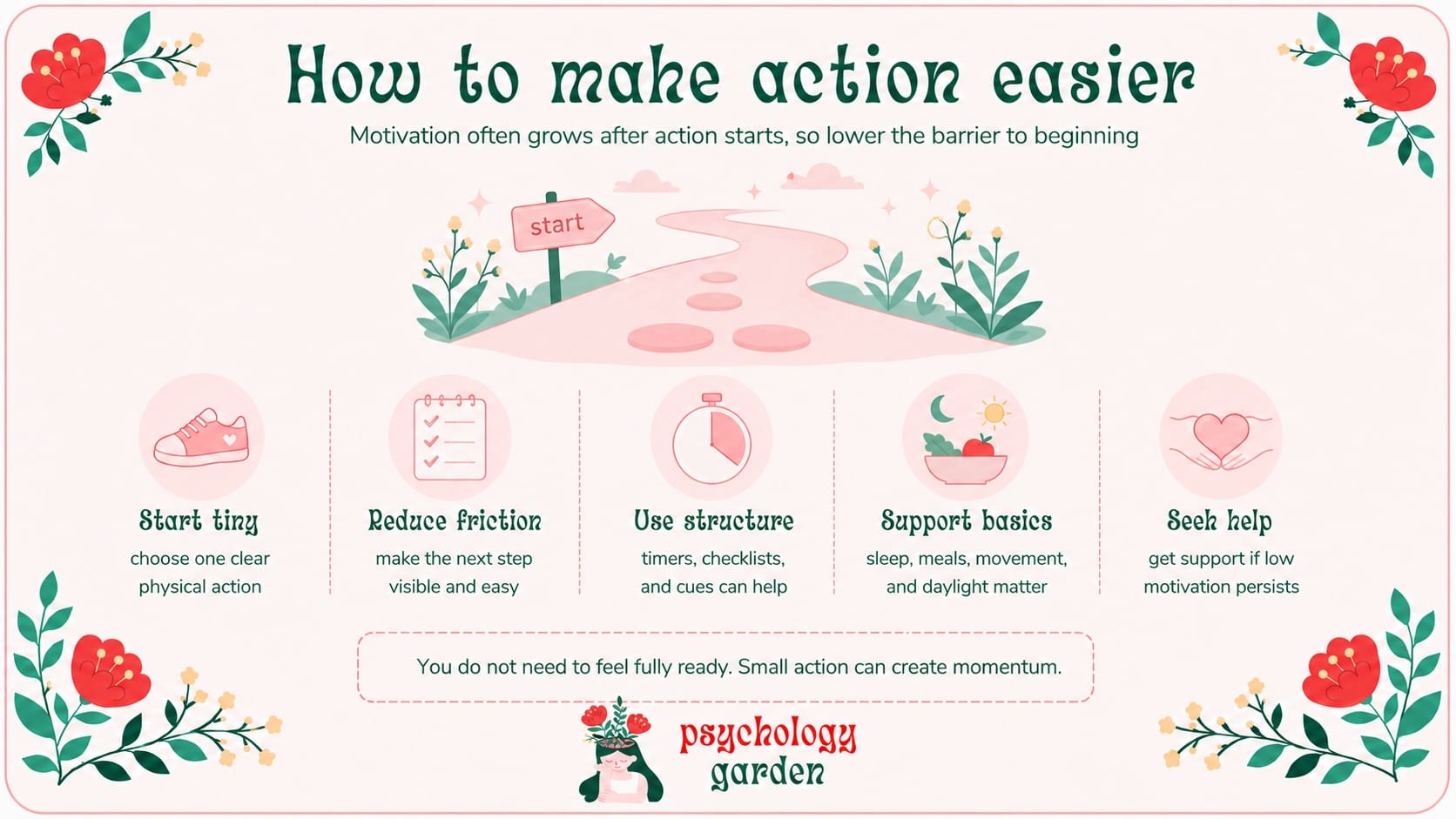
Start by choosing one action that would make the next hour slightly easier. This could mean eating something, drinking water, taking a shower, opening a window, replying to one message or writing the first sentence of an assignment. The action does not need to solve the entire problem.
This approach is not based on the idea that serious exhaustion or depression can be fixed by completing a tiny task. Its purpose is to reduce the barrier to movement and help you observe whether taking action creates any change in energy, mood or momentum.
If even a very small action repeatedly feels impossible, or if your ability to function continues to decline, the answer may not be to keep reducing the task. That may be a sign that you need medical or psychological support.
How can you make a task easier to start?
You can make a task easier to start by reducing it to one clear physical action. The first step should be smaller and more specific than the complete task.
Instead of telling yourself to clean the apartment, begin by putting one cup in the sink. Instead of finishing an assignment, open the document and write one rough sentence. Instead of completing a workout, change into exercise clothes and then decide whether to continue.
This idea is used in behavioral activation, a structured psychological approach that helps people rebuild routine, pleasure and a sense of achievement through planned activities. It recognizes that action can sometimes come before motivation rather than waiting for motivation to appear first.
The small step should not secretly mean that you must finish everything. Complete it, notice how you feel and then decide whether another step is manageable. Repeated actions can gradually become easier because of how the brain changes through experience, a process known as brain plasticity.
How can you reduce friction instead of relying on willpower?
Reducing friction means changing the task or environment so that beginning requires fewer decisions and less preparation. This is often more reliable than expecting willpower to overcome every obstacle.
Make the next action visible and specific. Leave the document open, prepare simple food before you become exhausted or write down the next physical step instead of using a vague reminder such as “work on project.” A clear instruction such as “open the spreadsheet and enter Monday’s figures” is easier to act on.
External structure can help when task initiation or attention regulation is difficult. Timers, reminders, visible checklists, clear deadlines and working beside another person can provide cues that may be difficult to generate internally.
It can also help to make distractions slightly harder to access. Place your phone in another room, turn off non-essential notifications or log out of an app that repeatedly interrupts you. The goal is not perfect self-control but an environment that requires less of it.
Can sleep, movement, meals and daylight improve motivation?
Sleep, movement, regular meals and daylight can support motivation by improving the physical conditions needed for attention, energy and emotional regulation. They are not cures for every cause of low motivation, but they can reduce avoidable strain.
Try to keep sleeping and waking times reasonably consistent when possible. Getting daylight earlier in the day may support your sleep-wake rhythm, while reducing highly stimulating activities near bedtime can make it easier to wind down.
Choose movement that matches your current capacity. A short walk, gentle stretching or a few minutes of exercise still count. Movement should support your energy and mood rather than become another demanding standard you feel unable to meet.
Eating regularly can also matter, particularly if long periods without food leave you shaky, irritable or foggy. When your capacity is low, simple food you can prepare and eat is more useful than an ideal meal that feels impossible to make.
When should you seek professional help for low motivation?
Consider seeking professional help when low motivation lasts for two weeks or longer, repeatedly returns or interferes with work, education, relationships, personal care or basic responsibilities. You do not need to identify the cause before asking for support, and there are many reasons people choose to go to psychotherapy.
A healthcare professional can assess your mood, sleep, stress, attention patterns, physical symptoms and medication use. Depending on what you describe, this may involve a mental health assessment, a physical examination or blood tests.
Seek support sooner if you are becoming increasingly withdrawn, feel persistently hopeless or can no longer manage basic daily needs. A noticeable and unexplained change from your usual level of functioning is enough reason to take the problem seriously.
If you are in immediate danger or believe you may harm yourself, contact local emergency services or a crisis service in your country immediately.
Final thoughts
Low motivation is not one problem with one universal solution. It may reflect exhaustion, stress, burnout, executive-function difficulties, reduced pleasure, physical illness or several factors occurring together.
Start by looking at the pattern rather than judging yourself. Notice when the change began, whether you still enjoy anything, which tasks are hardest and whether you have developed new emotional or physical symptoms. These details can help you decide whether you need rest, practical changes, medical support or a mental health assessment.
When possible, choose one useful action that is small and clear enough to begin. Motivation does not always appear first. Sometimes it develops after the first manageable step.
FAQs
A sudden loss of motivation may follow poor sleep, illness, intense stress, conflict, disappointment, medication changes or a demanding period. Think about what changed around the time the problem began, including changes in your physical health, mood, routine and responsibilities.
Yes. Low motivation can be caused by sleep deprivation, chronic stress, burnout, ADHD, physical illness, medication effects or temporary overload. Depression should still be considered when low motivation persists, affects functioning or appears with loss of interest, numbness or hopelessness.
Apathy is a reduction in motivation and goal-directed activity. Laziness is an informal judgment rather than a medical or psychological explanation, so it does not reveal why someone is struggling to act.
Yes. Poor sleep can reduce energy, concentration, emotional regulation and the ability to begin demanding tasks. Persistent sleep problems may need medical assessment, especially when they cause significant daytime impairment.
Yes. ADHD can affect planning, working memory, attention regulation and task initiation. Routine, unclear or delayed-reward tasks may be especially difficult, even when the person understands their importance.
Yes. Iron-deficiency anemia and an underactive thyroid can cause fatigue, low energy, concentration problems and mood changes. A healthcare professional can assess your symptoms and decide whether testing is appropriate.
Not necessarily. Beginning with a very small action may reduce the barrier to starting and create a sense of progress. However, persistent inability to function despite reducing the task may indicate that professional support is needed.
Sources
- National Institute of Mental Health: Depression
- World Health Organization: Depressive disorder
- World Health Organization: Burn-out as an occupational phenomenon
- NICE: Depression in adults, treatment and management
- CDC: ADHD in adults
- NHS: Underactive thyroid (hypothyroidism)
- NHS: Iron-deficiency anaemia
- NIH: Day-to-day fluctuations in motivation drive effort-based decision-making
- NIH: An inverted U-shaped relationship between chronic stress and the motivation to expend effort for reward