People go to psychotherapy for many reasons. Some are dealing with depression, anxiety, trauma, grief, or another mental health condition. Others want help with relationships, stress, difficult emotions, major life changes, or patterns they keep repeating.
You do not need to have a mental health diagnosis to go to therapy. Psychotherapy can also give you a structured space to understand what you are feeling, work through difficult experiences, and learn healthier ways of responding to problems.
Key takeaways
- People seek therapy for mental health conditions, stress, grief, trauma, relationship difficulties, recurring patterns, and major life changes.
- You do not have to wait until you are in crisis to talk to a therapist.
- Therapy can be particularly useful when a problem is persistent, keeps returning, or starts interfering with everyday life.
- Different types of psychotherapy work better for different problems.
- Therapy does not work equally well for everyone, and finding the right treatment and therapist matters.
- Feeling uncomfortable during some sessions can be normal, but persistent worsening should not simply be ignored.
A personal note on the stigma around therapy
I have seen a sentence circulating on social media that says, “Therapy only works if you have a lower IQ than the therapist.” People react to it, joke about it, and sometimes use it to mock people who go to psychotherapy.
But therapy has nothing to do with whether someone is intelligent.
Having a high IQ does not protect you from anxiety, depression, trauma, panic attacks, relationship difficulties, stress, or other mental health challenges. Intelligence and mental health are not opposites.
I go to therapy myself. Does that make me stupid? Of course not. My therapist has a therapist too, which is actually very common among mental health professionals.
For me, psychotherapy has helped me learn how to live in a healthier way, regulate my emotions better, stop taking everything so personally, and recognize what is happening when I start to feel overwhelmed. I have also learned practical techniques that help me manage and sometimes prevent a panic attack from escalating.
That is part of what therapy can offer. It is not about someone being “smarter” than you and telling you how to live. It is about learning to understand yourself, recognize patterns, build healthier coping skills, and deal with difficult experiences more effectively.
Why do people go to psychotherapy?
The simplest answer is that people usually go to psychotherapy because something in their thoughts, emotions, behavior, relationships, or daily life has become difficult to manage alone.
The National Institute of Mental Health describes psychotherapy as a group of treatments designed to help people identify and change troubling emotions, thoughts, and behaviors.
That can include treating a mental health condition, but it can also mean working through grief, relationship problems, long-term stress, major transitions, or patterns that keep causing difficulties.
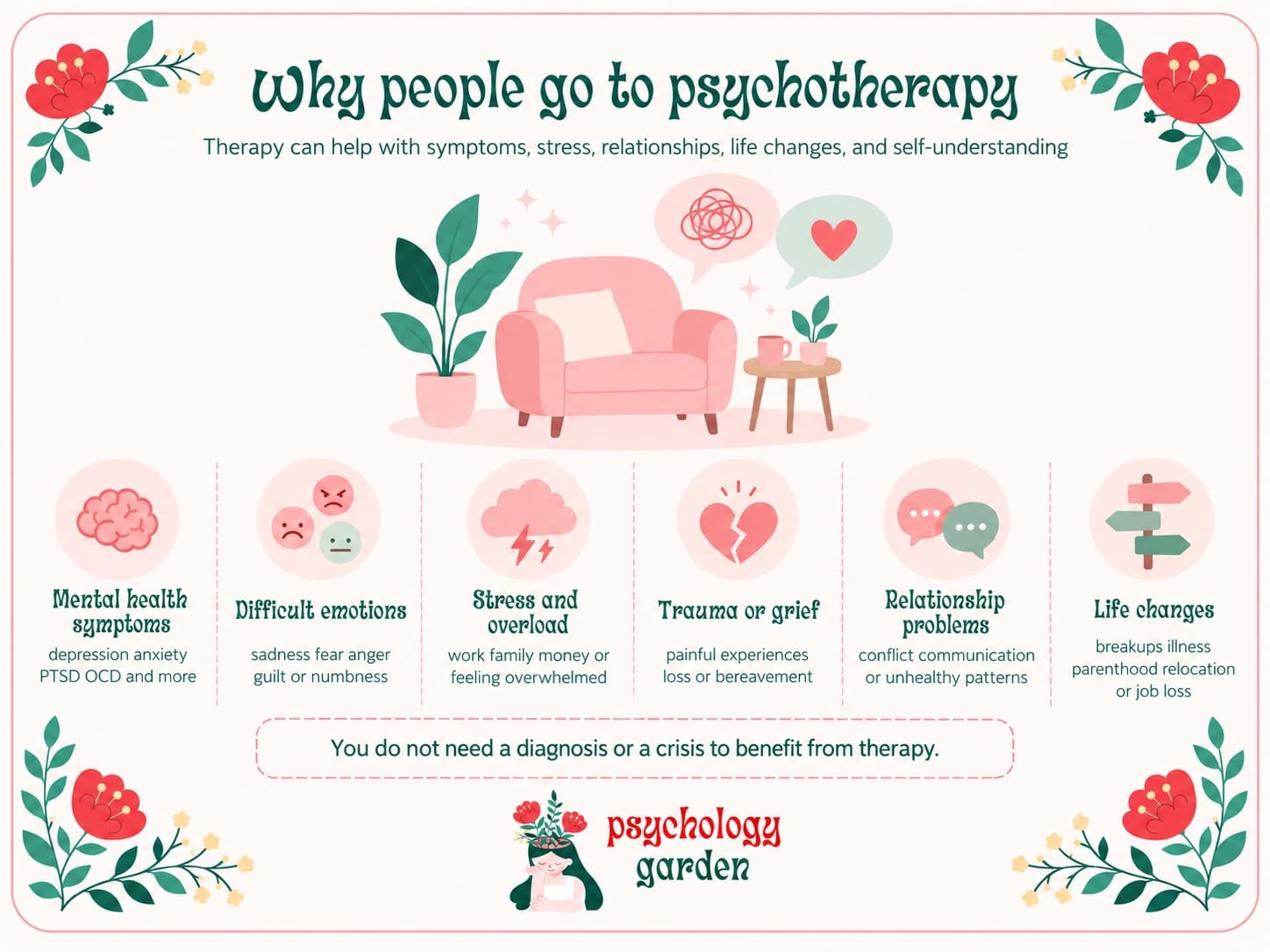
Common reasons include:
| Reason | What this might look like |
|---|---|
| Mental health symptoms | Depression, anxiety, PTSD, OCD, eating disorders, or another mental health condition |
| Emotional distress | Persistent sadness, fear, anger, guilt, irritability, shame, or numbness |
| Stress | Work pressure, family problems, financial stress, caregiving, or feeling overwhelmed |
| Trauma | Intrusive memories, avoidance, fear, hyperarousal, or difficulty functioning after a traumatic experience |
| Grief | Difficulty adjusting to bereavement or grief that remains severe and disruptive |
| Relationships | Conflict, communication problems, intimacy issues, or repeating unhealthy relationship patterns |
| Repeating patterns | Avoidance, self-defeating behaviors, difficult coping habits, or similar problems happening again and again |
| Life changes | Divorce, parenthood, relocation, illness, retirement, job loss, or another major transition |
| Self-understanding | Exploring your emotions, values, choices, identity, or relationships |
Therapy is not automatically necessary whenever life becomes difficult. Feeling anxious before an important event, sad after a loss, or stressed during a demanding week can all be normal responses.
The question is often whether the problem passes or whether it begins to stay with you.
If you find it difficult to identify exactly what you are feeling, learning how to understand your emotions can also help you notice patterns before deciding what kind of support you need.
How do you know if you might need therapy?
There is no single test that tells everyone when they “need” psychotherapy.
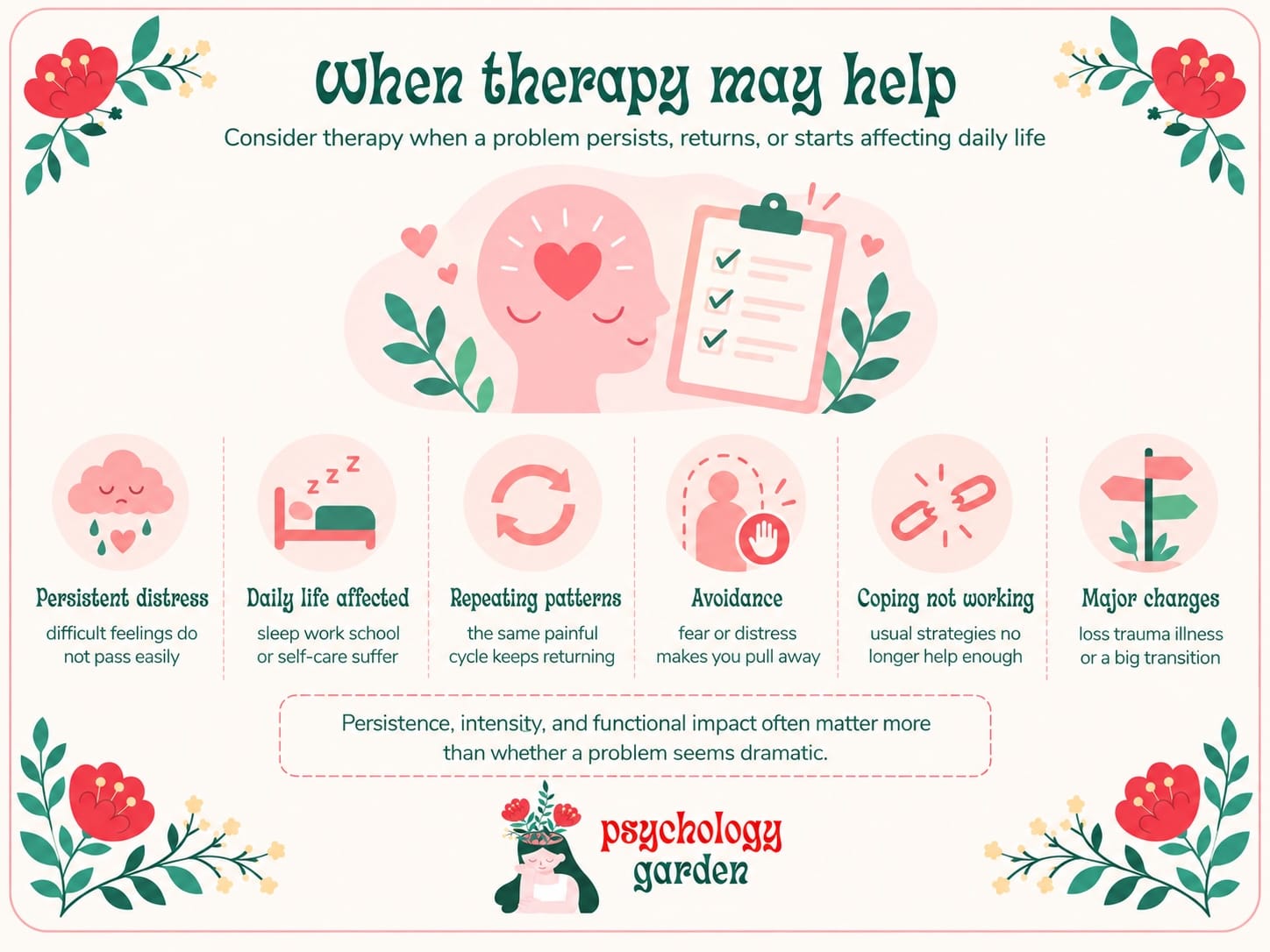
A more useful way to think about it is to look at three things: persistence, intensity, and how much the problem is affecting your life.
A bad week is different from feeling distressed for months. Occasional anxiety is different from avoiding work, social situations, travel, relationships, or everyday responsibilities because of fear.
Therapy may be worth considering if:
- difficult emotions feel persistent or increasingly hard to manage;
- the problem is affecting your sleep, work, relationships, school, or self-care;
- the same painful patterns keep happening;
- things you normally do to cope are no longer helping;
- you are avoiding situations, people, memories, or responsibilities because of distress;
- anger, fear, sadness, shame, or another emotion feels difficult to regulate;
- you are struggling to adjust after trauma, loss, illness, a breakup, or another major change;
- symptoms are getting worse rather than gradually improving.
Functional impairment is especially important. Mental health professionals do not look only at whether a symptom exists. They also look at what it is doing to your life.
For example, NICE guidance for social anxiety disorder asks clinicians to consider distress, avoidance, and the effect anxiety has on occupational, educational, financial, and social functioning.
An initial therapy appointment can help with this too. You do not have to decide beforehand whether your problem is “serious enough.” Part of an assessment is working out what is happening and whether psychotherapy is actually the right form of support.
Sometimes it may not be.
A problem may improve through time, practical changes, social support, medical treatment, self-help, or another type of care. Not every difficult human experience needs to be turned into a psychological disorder.
What can psychotherapy help with?
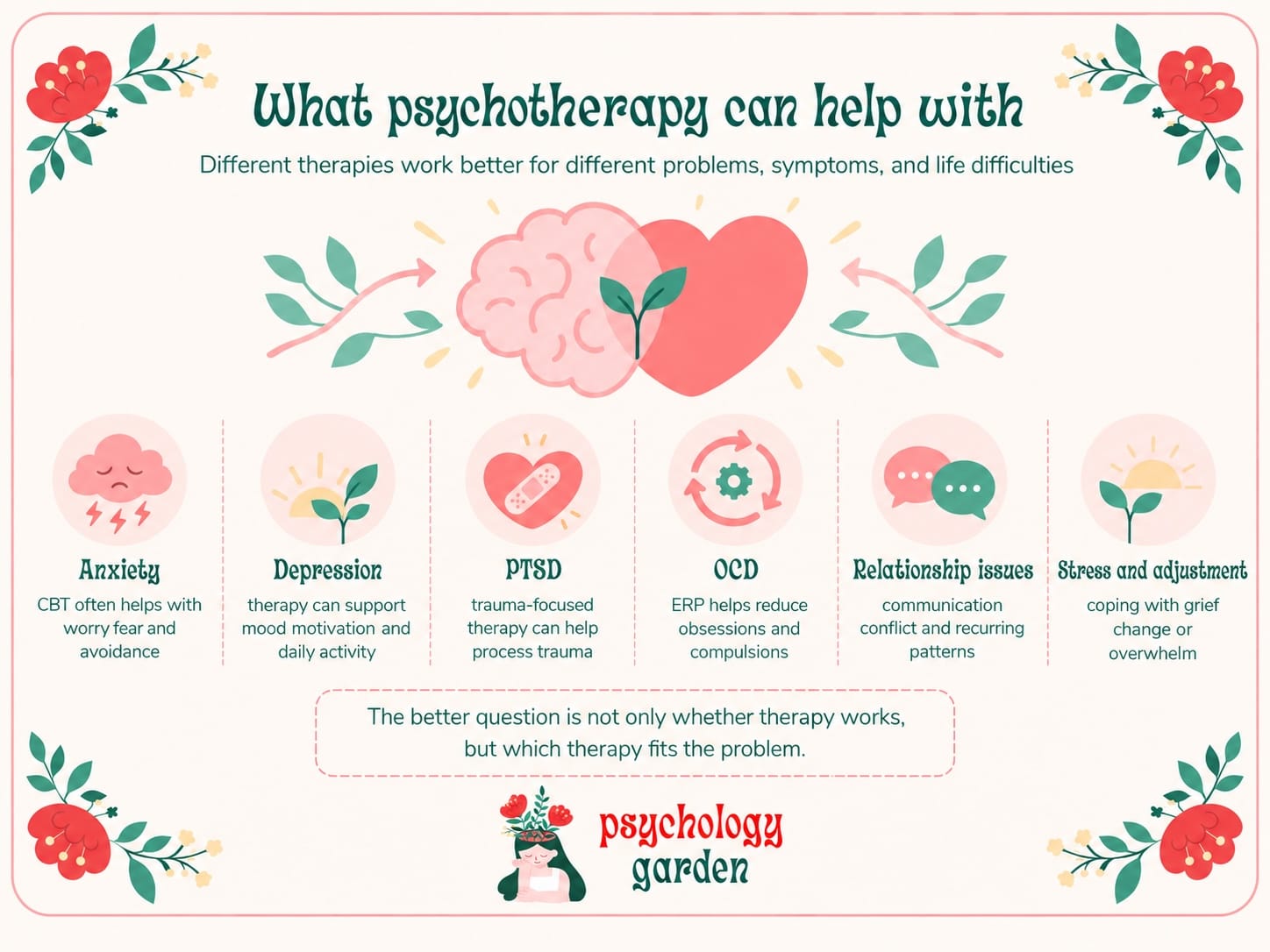
Psychotherapy can help with a wide range of mental health problems, but “therapy” is not one treatment.
Different therapies use different methods and are designed for different problems.
For example, exposure and response prevention used for OCD is quite different from interpersonal psychotherapy for depression or trauma-focused therapy for PTSD.
A large 2025 synthesis of 1,029 psychotherapy studies involving more than 85,000 patients found that psychological treatments were effective across several mental health conditions, although the size of the benefit differed considerably between disorders.
That is one reason it is more useful to ask, “Which psychotherapy works for this problem?” rather than simply asking whether therapy works in general.
Anxiety
For many anxiety disorders, cognitive behavioral therapy is one of the best-supported psychological treatments.
CBT usually looks at the relationship between thoughts, emotions, physical sensations, and behavior. For anxiety, it often includes gradually approaching situations that have become associated with fear instead of continually avoiding them.
NICE recommends CBT for conditions including generalized anxiety disorder and panic disorder, while its social anxiety guideline recommends disorder-specific individual CBT.
The exact treatment still depends on the type of anxiety. Social anxiety, panic disorder, phobias, and generalized anxiety disorder do not all involve exactly the same patterns.
Depression
There is no single psychotherapy that is best for every person with depression.
Evidence-based options include CBT, behavioral activation, behavioral therapy, and interpersonal psychotherapy. NICE’s depression guideline recommends different options depending on symptom severity, personal preferences, previous treatment, and other circumstances.
Behavioral activation, for example, focuses partly on reversing cycles of withdrawal and inactivity that can develop during depression.
A loss of interest and motivation can also occur for many reasons besides depression. If that is the symptom you are trying to understand, read more about why you may have no motivation to do anything.
PTSD
Psychotherapy for PTSD usually focuses more specifically on trauma.
NICE recommends trauma-focused CBT approaches, including cognitive processing therapy, cognitive therapy for PTSD, narrative exposure therapy, and prolonged exposure. EMDR is another recommended treatment for many adults with PTSD.
The American Psychological Association’s PTSD guideline also evaluates psychological treatments specifically for PTSD rather than treating all forms of therapy as interchangeable.
OCD
For OCD, one of the main evidence-based psychological treatments is cognitive behavioral therapy that includes exposure and response prevention, usually shortened to ERP.
ERP involves gradually encountering situations, thoughts, memories, or triggers associated with obsessive fear while reducing the compulsive response that normally follows.
NICE recommends CBT with ERP as a treatment for OCD, with treatment intensity depending partly on how severely symptoms are affecting everyday life.
OCD can also involve obsessive doubt about past events. Our guide to false memory OCD looks specifically at why uncertain memories can become the focus of checking and reassurance.
What are the main types of psychotherapy?
There is no official list of exactly four types of psychotherapy.
You may see articles referring to the “four main types,” but psychotherapy can be classified in several ways. The American Psychological Association, for example, describes five broad approaches: psychoanalytic and psychodynamic, behavioral, cognitive, humanistic, and integrative or holistic therapies.
Some of the approaches you are most likely to encounter include:
Cognitive behavioral therapy
CBT looks at the connections between thoughts, emotions, behavior, and physical responses.
Depending on the problem, therapy might involve recognizing thinking patterns, testing beliefs, changing behaviors, reducing avoidance, practicing coping skills, or completing exercises between sessions.
Psychodynamic therapy
Psychodynamic therapy explores recurring emotional and relationship patterns, including ways earlier experiences may continue to influence how someone relates to themselves and other people.
Sessions may focus on emotions, relationships, conflicts, defenses, and patterns that emerge both inside and outside therapy.
Humanistic and person-centered therapy
Humanistic therapies place greater emphasis on a person’s own experience and capacity for growth.
Person-centered therapy, for example, emphasizes empathy, acceptance, authenticity, and creating a therapeutic environment where someone can explore their experiences without being directed toward a predetermined answer.
Interpersonal psychotherapy
Interpersonal psychotherapy, or IPT, focuses on the relationship between psychological symptoms and current relationships or life circumstances.
It has particularly strong evidence as a treatment for depression and may focus on grief, interpersonal conflict, relationship difficulties, or major role transitions.
These are only a few examples.
Other approaches include dialectical behavior therapy, acceptance and commitment therapy, EMDR, behavioral activation, family therapy, systemic therapy, mentalization-based therapy, and disorder-specific forms of CBT.
The therapy label alone also does not tell you whether a treatment is suitable.
A more useful question is whether the therapist is trained to treat the particular problem you are experiencing and can explain why they are recommending that approach.
Why does psychotherapy work?
Psychotherapy probably works through several processes rather than one single mechanism.
Some of those processes are shared across many therapies. Others are specific to the treatment being used.
The relationship with the therapist matters
A good therapeutic relationship is more than simply liking your therapist.
Researchers often use the term therapeutic alliance to describe the bond between therapist and client, together with agreement about treatment goals and what they are doing to reach them.
A large meta-analysis of 295 studies involving more than 30,000 people found a consistent association between a stronger therapeutic alliance and better treatment outcomes.
That does not mean the relationship alone explains why therapy works. Different therapies also contain specific techniques designed to change the processes maintaining a problem.
Therapy can change patterns of thinking and behavior
CBT, for example, can help people notice automatic thoughts, test beliefs, reduce avoidance, solve problems, and change behaviors that are keeping a problem going.
These changes are usually not instantaneous. New responses become easier through practice and repeated experience.
More broadly, the brain itself remains capable of changing in response to experience, a process known as brain plasticity.
Exposure can create new learning
Fear often encourages avoidance.
Avoidance can provide immediate relief, but it can also prevent someone from learning that a feared situation is manageable or that the expected outcome may not occur.
Exposure therapy works by gradually approaching feared situations, sensations, memories, or thoughts under controlled conditions.
Modern research suggests that exposure does not simply “erase” a fear. Instead, it can create new learning that competes with the old threat expectation. This is described in an influential review of inhibitory learning and exposure therapy.
Behavior can influence mood
Therapies such as behavioral activation also work from the opposite direction.
Instead of waiting until motivation or mood improves before doing anything, behavioral activation gradually increases involvement in meaningful or rewarding activities.
This can help interrupt the withdrawal and inactivity that often develop during depression.
Overall, psychotherapy works through a combination of learning, behavior change, emotional processing, new ways of interpreting experiences, relationship processes, and skills specific to the treatment being used.
What should you expect from psychotherapy?
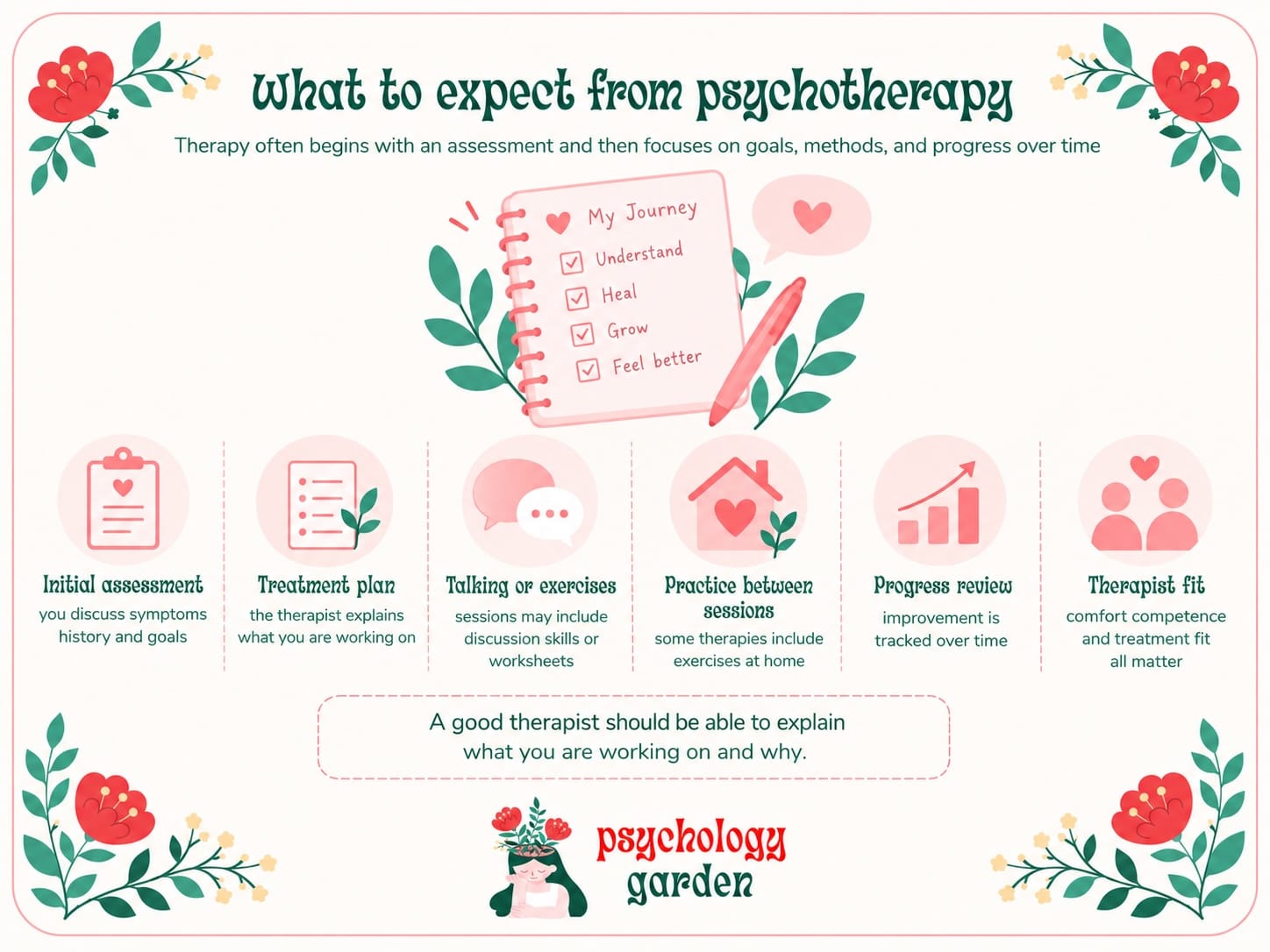
Psychotherapy usually begins with an assessment.
A therapist may ask what brought you in, what symptoms or difficulties you are experiencing, when they started, how they affect your life, and what you would like to change.
You may also discuss your history, medications, relationships, physical health, previous treatment, safety concerns, confidentiality, fees, and scheduling.
The exact structure after that depends on the type of therapy.
Some sessions mainly involve discussion. Others include worksheets, behavioral experiments, exposure exercises, skills practice, symptom tracking, or things to work on between appointments.
A good therapist should also be able to explain what you are working on and why.
How long does psychotherapy take?
There is no standard number of psychotherapy sessions.
Some structured treatments last only a few months, while people with more complex or long-standing problems may need longer treatment.
For example, NICE guidance for PTSD says trauma-focused CBT is usually delivered over around 8 to 12 sessions, although more may be needed.
Depression treatments vary as well. NICE describes some interventions lasting around 6 to 8 sessions, while others may involve 12 to 16 sessions or longer depending on the approach and the person’s needs.
These numbers are examples rather than deadlines.
Therapy should not continue simply because a certain number of sessions is considered “normal.” Progress, treatment goals, symptoms, functioning, and individual circumstances all matter.
Is psychotherapy worth it?
For many mental health conditions, evidence-based psychotherapy can produce meaningful improvements.
Whether therapy feels worth it for one individual is more personal.
Cost, time, access, the severity of the problem, treatment quality, therapist fit, and the availability of other options can all influence that decision.
It is reasonable to ask a therapist:
- What are we treating?
- What type of therapy are we using?
- Why is this approach appropriate?
- What changes should we expect to see?
- How will we know whether I am improving?
- What happens if the treatment is not helping?
The NIMH psychotherapy guide similarly recommends asking about a therapist’s qualifications, specialty, proposed treatment, and how that treatment is expected to help.
Do you always feel better after therapy?
Not necessarily.
Some sessions may leave you relieved, calmer, or clearer about something. Others may leave you tired, upset, or emotionally activated because you have been discussing difficult experiences.
Temporary discomfort does not automatically mean therapy is harmful.
At the same time, the idea that therapy always has to “get worse before it gets better” can be misleading.
Persistent worsening deserves attention.
Researchers are increasingly studying unwanted effects of psychotherapy. A 2024 qualitative meta-analysis found that negative experiences can involve poor treatment fit, problems in the therapeutic relationship, therapist behavior, and negative effects attributed to treatment.
If your symptoms are consistently worsening, you feel unsafe with the therapist, or you do not understand why a particular treatment is being used, those concerns are worth discussing.
What are the disadvantages of psychotherapy?
Therapy has potential benefits, but it also has limitations.
Possible disadvantages include:
- financial cost;
- waiting lists and difficulty accessing care;
- the time required for sessions;
- emotional discomfort;
- privacy concerns;
- between-session work;
- poor fit with a particular therapist;
- receiving a treatment that is not well suited to the problem;
- not improving despite investing time and money.
Access itself is a major problem. The World Health Organization has highlighted lack of available services, limited capacity, accessibility, and affordability as major barriers to psychological treatment worldwide.
There is also no guarantee that the first therapist you meet will be the right one.
Rapport matters, but so do competence and treatment fit. Feeling comfortable with someone does not replace receiving an appropriate treatment for the problem you are trying to address.
Can psychotherapy make you worse?
Some people do experience deterioration during psychotherapy, but available research does not suggest that evidence-based psychotherapy generally makes people worse.
In a meta-analysis of psychotherapy for adult depression, the median deterioration rate among psychotherapy groups was around 4%. The researchers also found that deterioration was less common among people receiving psychotherapy than among control groups.
A later 2021 meta-analysis similarly found lower deterioration rates among people receiving psychotherapy than among people in usual-care or waiting-list groups.
These figures should not be treated as a universal risk percentage for every therapy or every mental health condition.
One important problem is that adverse effects have historically been measured less consistently than treatment benefits. A systematic review of psychotherapy research found considerable inconsistency in how harmful or unwanted effects were defined and monitored.
So the more useful message is not that therapy is completely risk-free, but that persistent deterioration should be taken seriously and monitored rather than automatically dismissed.
What is the success rate of psychotherapy?
There is no single meaningful “success rate” for psychotherapy.
Different studies define success in different ways. One might measure whether symptoms fall by a certain amount, another might look at remission, and another might focus on daily functioning, quality of life, relationships, or relapse.
Results also vary by condition and treatment.
For example, a 2021 meta-analysis of psychotherapy for depression found that about 41% of people receiving psychotherapy met the study’s definition of treatment response, compared with 17% receiving care as usual and 16% on waiting lists.
That does not mean psychotherapy has a “41% success rate.”
Those numbers apply specifically to depression studies using particular definitions of improvement and particular follow-up periods.
The much larger 2025 analysis covering 12 mental health problems also found that treatment effects varied considerably between conditions.
That is why condition-specific evidence tells us much more than a universal therapy success percentage ever could.
When should you seek urgent help instead?
Routine psychotherapy is not designed to replace emergency mental health care.
Seek urgent local help if you or someone else is in immediate danger, you cannot keep yourself or another person safe, or there is a severe loss of contact with reality or another acute psychiatric emergency.
Where you seek help depends on the country you are in. This may include emergency medical services, a crisis service, an emergency department, or another urgent mental health service.
Final thoughts
People go to psychotherapy because something has become difficult enough that professional support may help.
Sometimes that means treating depression, anxiety, PTSD, OCD, or another mental health condition. Sometimes it means working through grief, relationships, stress, difficult emotions, or a major period of change.
You also do not need to wait until life becomes unbearable.
A useful question is not simply “Do I need therapy?” but whether something keeps affecting your wellbeing or daily life, whether your usual ways of coping are helping, and whether professional guidance could help you understand or change the pattern.
Yes. You do not need a psychiatric diagnosis to talk to a therapist.
People also seek therapy for relationships, stress, grief, difficult transitions, recurring patterns, self-understanding, or decisions they are struggling with.
Whether ongoing therapy is useful depends on what you want from it and whether it is helping you move toward those goals.
Look at the reason you started therapy.
Improvement might mean less anxiety, fewer depressive symptoms, reduced avoidance, better relationships, improved sleep, greater emotional regulation, better daily functioning, or being able to handle situations that previously felt overwhelming.
Progress does not always mean feeling good after every individual session.
Many structured psychotherapies use weekly sessions, particularly at the beginning of treatment.
Frequency can vary depending on the therapy, the problem being treated, severity, availability, and the treatment plan.
The terms overlap, but they are not always used in exactly the same way.
Psychotherapy broadly refers to psychological treatments designed to address emotional, behavioral, interpersonal, or mental health problems.
“Counseling” can describe a profession, service, or type of psychological support, and its meaning varies between countries.
It is usually more useful to look at a clinician’s qualifications, experience, and treatment approach than the title alone.
Some sessions can temporarily bring up sadness, anxiety, anger, or emotional exhaustion, especially when difficult experiences are being discussed.
That is different from symptoms consistently deteriorating over time. Persistent worsening should be discussed with the therapist rather than automatically treated as proof that the therapy is “working.”
The first appointment is usually partly an assessment.
The therapist may ask what brought you to therapy, what difficulties you are experiencing, how they affect your life, relevant history, previous treatment, and what you would like to change.
You can also use the session to ask about the therapist’s approach, qualifications, confidentiality, treatment plan, fees, and what future sessions are likely to involve.
Sources:
- National Institute of Mental Health: Psychotherapies
- American Psychological Association: Different approaches to psychotherapy
- NICE: Depression in adults: treatment and management
- NICE: Generalised anxiety disorder and panic disorder in adults: management
- NICE: Social anxiety disorder: recognition, assessment and treatment
- NICE: Post-traumatic stress disorder
- NICE: Obsessive-compulsive disorder and body dysmorphic disorder: treatment
- PubMed: Effectiveness of psychotherapy: synthesis across 12 mental health problems
- PubMed: The alliance in adult psychotherapy: a meta-analytic synthesis
- PubMed: Maximizing exposure therapy: an inhibitory learning approach
- PubMed: The effects of psychotherapies for depression on response, remission, reliable change, and deterioration
- PubMed: Negative effects of psychotherapies for adult depression: a meta-analysis of deterioration rates
- PubMed: Defining and assessing adverse events and harmful effects in psychotherapy study protocols
- PubMed Research: Negative experiences in psychotherapy from clients’ perspective
- World Health Organization: WHO launches new manual to support delivery of psychological interventions