Key takeaways
- Neurons communicate at the synapse by passing a message from one cell to another. The message travels as an electrical signal inside the neuron, but it usually becomes a chemical message when it crosses to the next cell.
- A synapse is the tiny space between the sending neuron and the receiving cell. Neurotransmitters carry the message across that space, and receptors on the next cell help read the message.
- Synapses matter because they help the brain learn, remember, move, react to stress, build habits, and change through experience.
How do neurons communicate?
Neurons communicate with each other using electrical and chemical signals. Electrical signals travel within neurons, while chemical messengers called neurotransmitters usually carry information between neurons across a synapse. This neural communication process begins when an action potential travels down the axon and triggers neurotransmitters to carry the message to the next cell.
What type of communication do neurons use?
Neurons use electrochemical communication. This means communication is electrical within a neuron and usually chemical between neurons across synapses.
How does synaptic communication work?
Synaptic communication is the process by which a message travels from one neuron to another across a synapse. It happens in seven main steps, beginning with an electrical signal traveling down the neuron and ending when neurotransmitters are cleared from the synapse.
Here is the process step by step:
- An electrical signal travels down the neuron
The message starts as an electrical signal called an action potential. It moves down the axon, which is the long part of the neuron. - The signal reaches the end of the neuron
When the action potential reaches the presynaptic terminal, it tells the neuron that it is time to send the message to the next cell. - Calcium enters the terminal
Calcium moves into the end of the neuron. This works like a trigger. It helps the neuron release its chemical message. - Neurotransmitters are released
Tiny sacs called vesicles release neurotransmitters into the synaptic cleft. Neurotransmitters are the chemical messengers of the nervous system. - The neurotransmitters cross the synaptic gap
The neurotransmitters move across the tiny space between the sending neuron and the receiving cell. - Receptors receive the message
The neurotransmitters attach to receptors on the next cell. This is how the receiving cell “reads” the message. - The signal is cleared away
After the message is sent, the neurotransmitter is removed through reuptake, enzyme breakdown, or diffusion. This helps the synapse reset for the next message.
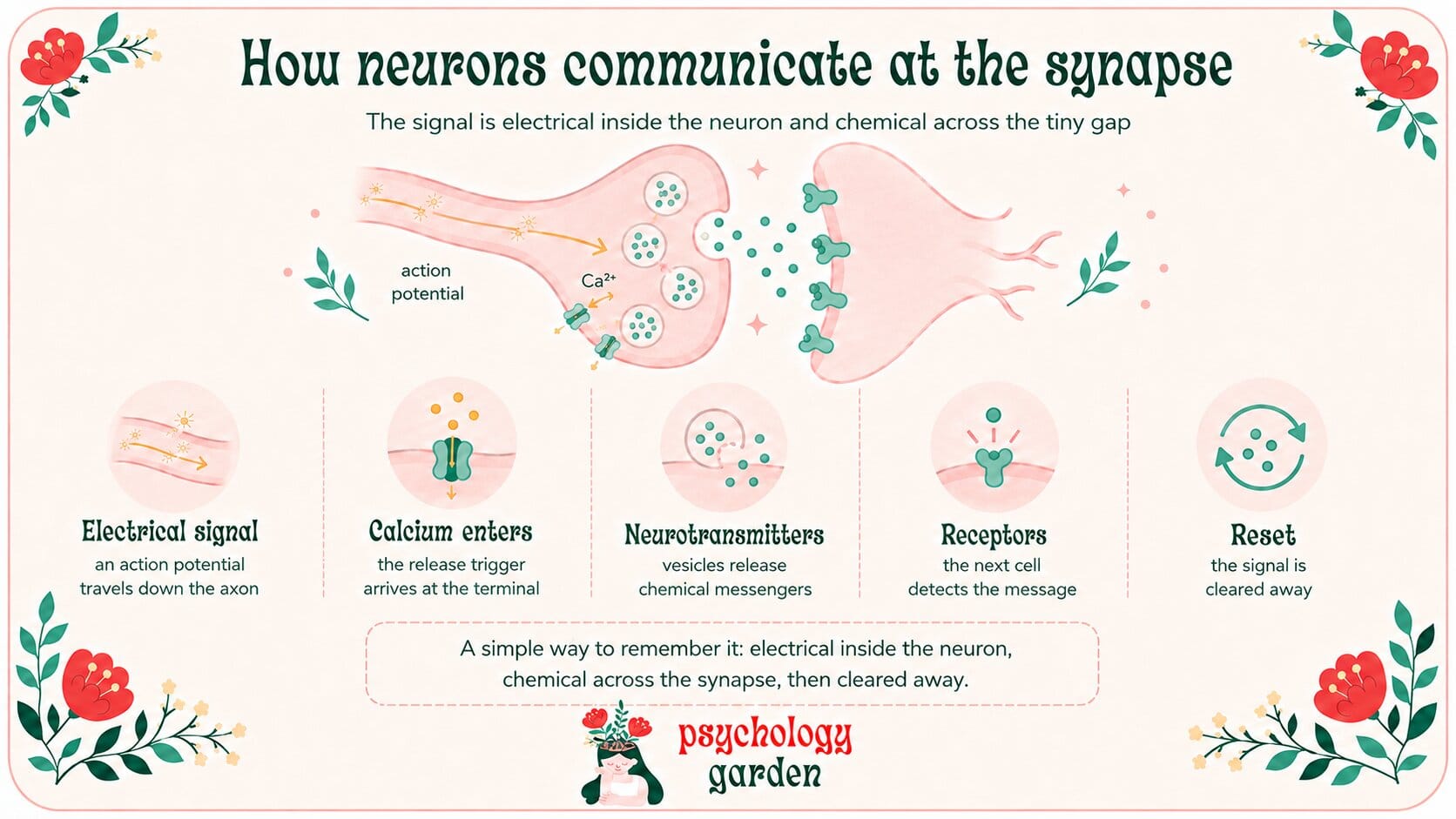
NCBI Bookshelf describes synaptic transmission as a stepwise process that includes neurotransmitter synthesis, release, receptor activation, and signal termination.
| Step | What happens | Simple meaning |
|---|---|---|
| 1. Electrical signal | An action potential travels down the axon. | The message moves through the neuron. |
| 2. Arrival at the terminal | The action potential reaches the presynaptic terminal. | The neuron prepares to send the message. |
| 3. Calcium trigger | Calcium enters the end of the neuron. | Calcium triggers the release process. |
| 4. Neurotransmitter release | Vesicles release neurotransmitters into the synaptic cleft. | The neuron releases its chemical message. |
| 5. Synaptic crossing | Neurotransmitters cross the synaptic gap. | The message moves between cells. |
| 6. Reception | Neurotransmitters bind to receptors on the receiving cell. | The next cell reads the message. |
| 7. Reset | Neurotransmitters are cleared through reuptake, enzyme breakdown, or diffusion. | The synapse gets ready for the next signal. |
What is a synapse?
A synapse is the point of communication between two neurons, or between a neuron and another type of cell. It includes the sending terminal, the tiny synaptic cleft, and receptors on the receiving cell. At most synapses, chemical messengers called neurotransmitters carry information across the gap.
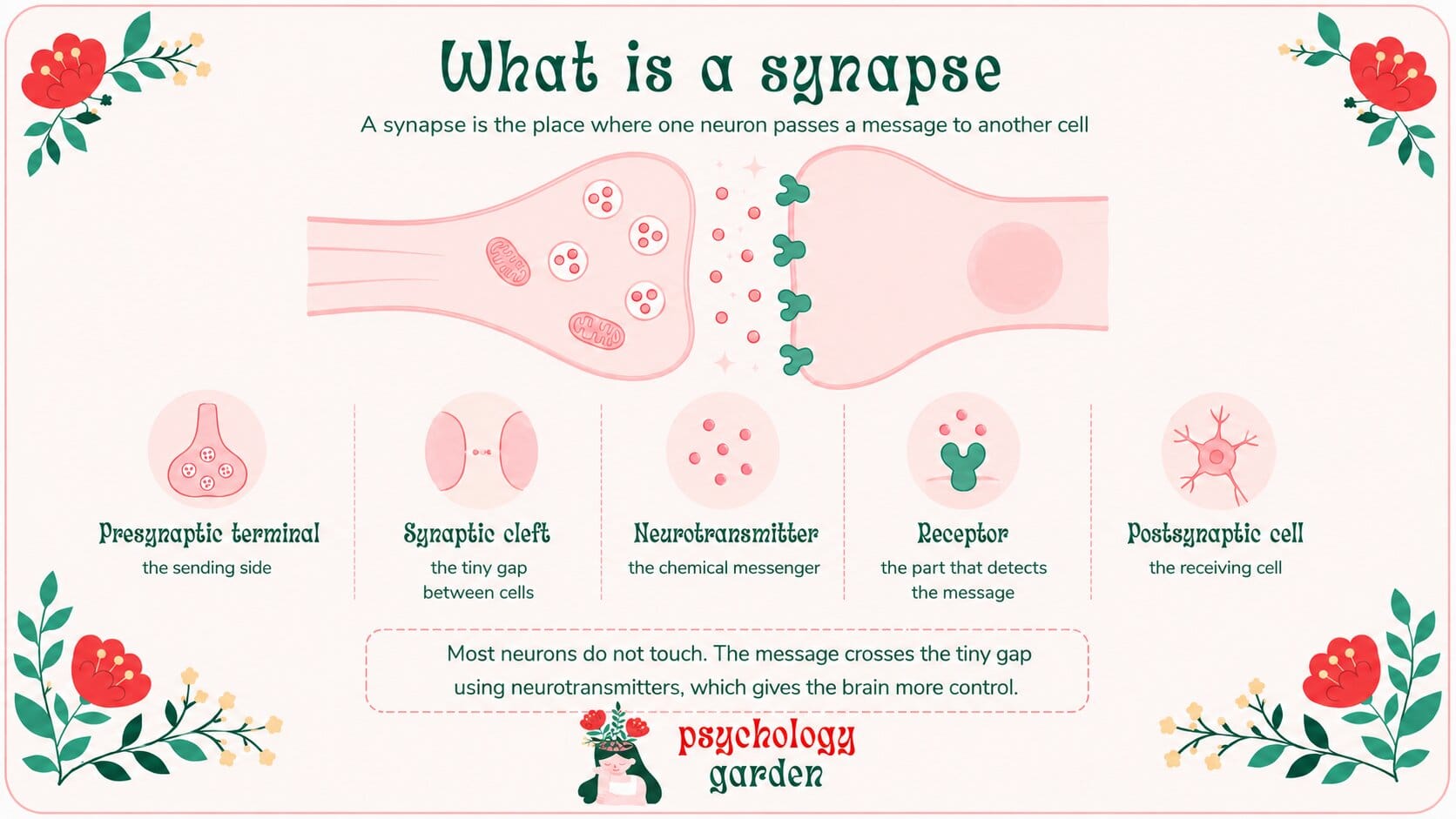
Most neurons do not fully touch at chemical synapses. They are very close, but there is still a small space between them. NCBI Bookshelf explains that the postsynaptic side is less than 50 nanometers away from the presynaptic side, and the neurotransmitter quickly crosses this tiny cleft.
| Part | Simple meaning |
|---|---|
| Presynaptic Terminal | The part of the neuron that sends the message. |
| Synaptic Cleft | The tiny space between the sending neuron and the receiving cell. |
| Neurotransmitter | The chemical message that travels across the gap. |
| Receptor | The “receiver” on the next cell that catches the message. |
| Postsynaptic Cell | The cell that receives the message and responds to it. |
This tiny gap gives the brain more control. A message can be strengthened, weakened, repeated, blocked, or changed depending on what the brain needs.
Where is the synapse?
A synapse is found wherever two brain cells meet. It is not a part of one neuron. It is the small connection point between the sending cell and the receiving cell, so it only exists in the space where they come close together.
Synapses are not in just one spot in the body. They are everywhere your nerves are. That means all through your brain, down your spinal cord, and out into the nerves that reach the rest of your body. They are packed most tightly inside the brain, where a single neuron can connect to thousands of nearby cells.
Add all of those connections up and you get a very large number. The brain’s roughly 86 billion neurons form an estimated 100 trillion synapses. The exact count varies because “counting” synapses is harder than it sounds, and researchers must decide whether to count only strong, stable connections or include weaker, temporary ones.
One helpful example lives outside the brain. There is a synapse at the spot where a nerve meets a muscle. When you decide to lift your arm, a message travels down a nerve and crosses that synapse to tell the muscle to move. So a synapse is not only a brain thing. It is the small bridge that turns a thought into an action, all over your body.
Chemical vs electrical synapses
Communication between neurons can be chemical or electrical, depending on the type of synapse. Chemical communication between neurons uses neurotransmitters to cross a tiny gap, while electrical synapses allow current to pass more directly between cells.
Most synapses in the brain are chemical synapses. They are slightly slower than electrical synapses, but they are more flexible because they can use different neurotransmitters and receptors.
Electrical synapses are usually faster because the signal passes more directly between cells. NCBI Bookshelf explains that electrical synapses use connexin channels that allow current to pass from one neuron to another, while chemical synapses rely on neurotransmitters.
| Type of synapse | How the message moves | Simple explanation |
|---|---|---|
| Chemical synapse | Neurotransmitters cross a tiny gap. | Common, flexible, and important for learning, mood, memory, and habits. |
| Electrical synapse | Electrical current passes more directly between cells. | Faster, more direct, and more specialized. |
What happens after neurotransmitters send the message?
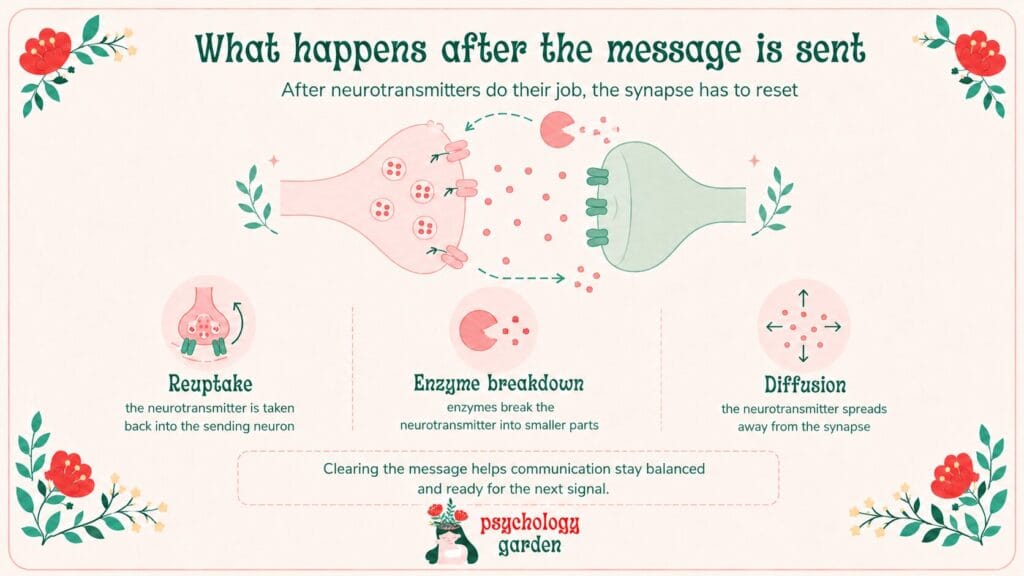
After neurotransmitters send the message, they have to be cleared away from the synapse. This helps the synapse reset so it can send the next message clearly.
This can happen in a few ways. The neurotransmitter may be taken back into the sending neuron, which is called reuptake. It may be broken down by enzymes. Or it may move away from the synapse. NCBI Bookshelf lists reuptake, enzymatic destruction, and diffusion as main ways neurotransmitter signals are ended.
This reset step matters because the brain needs clean signals. If the chemical message stayed in the synapse for too long, the receiving cell could keep getting the same signal even after the message should be finished.
In simple terms, the synapse does not only send the message. It also has to stop the message at the right time.
Why is a synapse more than just a gap?
A synapse is more than just a gap because it does not pass every message in the same way. It helps control whether a signal is passed on, slowed down, strengthened, or made less important.
This is why a synapse is not like a simple wire. A wire sends electricity directly from one point to another. A chemical synapse works more like a handoff point. The message has to be released, received, interpreted, and cleared away.
Depending on which neurotransmitter is released, the signal can either excite or inhibit the next cell. Excitatory signals (like glutamate) make the receiving cell more likely to fire. Inhibitory signals (like GABA) make the receiving cell less likely to fire.
Some neurotransmitters, like dopamine and serotonin, can work both ways depending on which receptor they bind to. Dopamine shapes how the brain’s reward system works by deciding what’s worth paying attention to and repeating. This flexibility is why synapses are powerful, the same gap between neurons can amplify a signal, quiet it down, or shift how the brain prioritizes different messages.
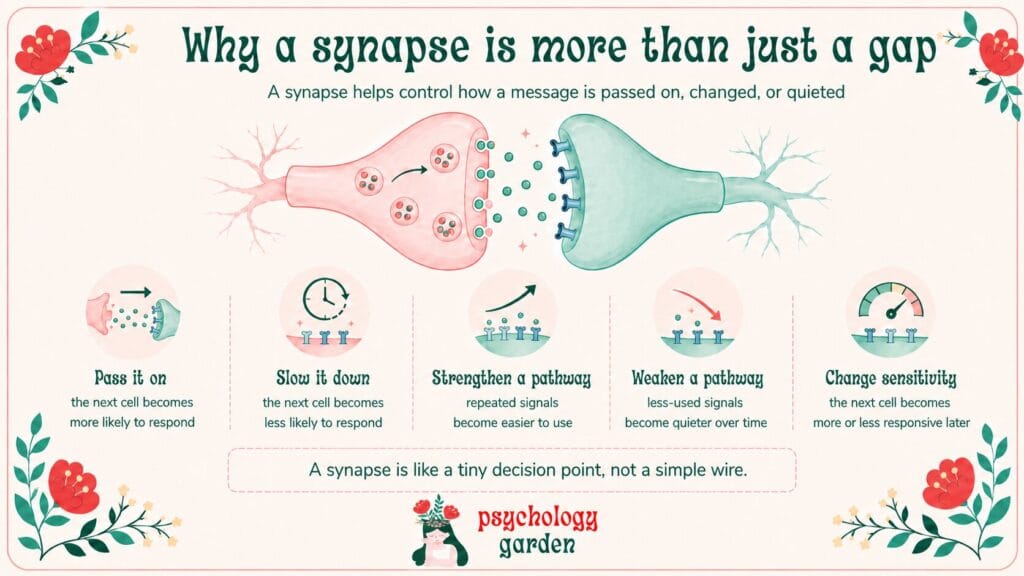
| What the synapse can do | Simple meaning | Everyday example |
|---|---|---|
| Pass the message on | The next cell becomes more likely to respond. | You touch something hot and pull your hand away. |
| Slow the message down | The next cell becomes less likely to respond. | Your brain filters out background noise while you read. |
| Strengthen a pathway | Repeated signals become easier to use. | Practicing a song makes it feel smoother. |
| Weaken a pathway | Less-used signals become quieter over time. | An old habit may feel less automatic after you stop repeating it. |
| Change sensitivity | The next cell becomes more or less responsive later. | Stress may make threat-related signals feel louder. |
Why do synapses matter for learning and memory?
Synapses matter for learning and memory because they help brain cells change how strongly they communicate. When you practice something, remember something, or repeat a habit, synapses are part of the process.
For example, when you learn to drive, the brain gets better at using pathways involved in attention, movement, and decision-making. At first, everything feels difficult. After enough practice, the same actions feel easier because the brain has used those pathways many times.
This is connected to brain plasticity. If a pathway is used often, the connections involved can become stronger. If it is used less, it can become weaker over time. This does not mean the brain changes instantly. It means repeated experience can slowly shape how strongly brain cells communicate.
Synapses also change as the brain develops. A 2026 Nature Communications study on the mouse hippocampus, a brain area linked to memory, tested 7,736 possible neuron connections. The researchers found that one memory-related circuit became less densely connected over time, with measured connection probability dropping from 3.38% early in development to 0.91% later on.
In simple words, the brain was not just adding more connections. It was becoming more selective. That matters because brain development is not only about growth. It is also about organization.
How are synapses connected to stress and mental health?
Synapses are connected to stress and mental health because stress affects how brain cells communicate. When the body experiences acute stress, the brain’s stress response systems activate, which can temporarily reduce synaptic density, the number and strength of connections in certain brain areas.
One 2026 PET imaging study of 78 people (including those with first-episode psychosis, at-risk individuals, and healthy controls) found that greater acute stress correlated with lower synaptic density across all groups. This doesn’t mean stress permanently destroys synapses; rather, stress can prune weaker connections or temporarily reduce transmission efficiency as the brain prioritizes survival-focused pathways.
Over time, chronic stress may lead to lasting changes in how densely certain brain regions are connected, which can affect mood regulation, attention, and threat detection.
This is why people under prolonged stress often notice changes in memory, focus, and emotional reactivity. To understand what’s actually happening, it helps to recognize which brain pathways are getting louder during stressful moments, a skill that ties directly into understanding your emotions more broadly.
Final thoughts
Neurons communicate by combining electrical and chemical signals. An action potential travels through the neuron, neurotransmitters cross the synapse, and receptors on the receiving cell help continue the message.
This process is called electrochemical communication. In simple terms, communication is electrical within the neuron and chemical across most synapses, allowing messages to pass from one nerve cell to the next.
FAQs
Neurons communicate with each other using electrical signals within the cell and chemical signals between cells. In most synapses, neurotransmitters carry the message across the synaptic gap and bind to receptors on the receiving cell.
A synapse is the place where one neuron passes a message to another cell. In most synapses, the message crosses a tiny gap using chemical messengers called neurotransmitters.
No. In most chemical synapses, neurons are separated by a tiny gap called the synaptic cleft.
It is both. The signal is electrical inside the neuron, but it usually becomes chemical when it crosses the synapse.
Calcium helps trigger the release of neurotransmitters. When calcium enters the end of the neuron, it tells vesicles to release their chemical message.
Yes. Synapses can change with learning, development, stress, injury, and repeated experience. This is one reason the brain can adapt over time.
Neurons release chemical messengers called neurotransmitters. Examples include dopamine, serotonin, glutamate, GABA and acetylcholine.
Messages travel across most synapses when one neuron releases neurotransmitters into the synaptic cleft. The neurotransmitters cross the gap and bind to receptors on the receiving cell, allowing the signal to continue.
Sources
- NCBI Bookshelf: Physiology, synapse
- NCBI Bookshelf: Neurotransmitter release and removal
- Nature Communications 2026: Developmental emergence of sparse and structured synaptic connectivity in the hippocampal CA3 memory circuit
- Translational Psychiatry 2026: Stress and synaptic density in psychosis and clinical high risk
- UCLA: Billions of neurons, trillions of synapses