Key takeaways
- The brain reward system helps us notice what feels rewarding, remember it, and feel motivated to seek it again.
- Dopamine is not only about pleasure. It is more about wanting, motivation, anticipation, and learning from rewards.
- The reward system involves brain areas that support motivation, memory, emotion, decision-making, and habit formation.
- Habits form when the brain connects a cue, a behavior, and a reward until the pattern becomes automatic.
- A healthier reward system is supported by small wins, movement, sleep, novelty, connection, creativity, and meaningful long-term rewards.
Intro
Why does finishing a task feel satisfying, while checking your phone can become almost automatic? The answer is partly connected to the brain’s reward system.
The brain reward system is a network of connected brain regions that helps us notice rewards, learn from them, and feel motivated to repeat certain behaviors. It influences motivation, habits, pleasure, learning, and decision-making.
It is not only about feeling good. The reward system also helps the brain decide what matters, what is worth remembering, and what actions may be worth repeating.
What is the brain reward system?
The reward system in the brain is a network of connected areas that responds when we experience or expect something rewarding. Rewards can include food, social connection, achievement, music, exercise, learning, or anything the brain considers valuable.
Dopamine is one of the main chemicals involved. It helps with motivation, anticipation, attention, and learning from rewards. Rather than simply saying, “This feels good,” dopamine helps signal, “This matters. Pay attention and remember what led to it.”
Where is the reward system in the brain?
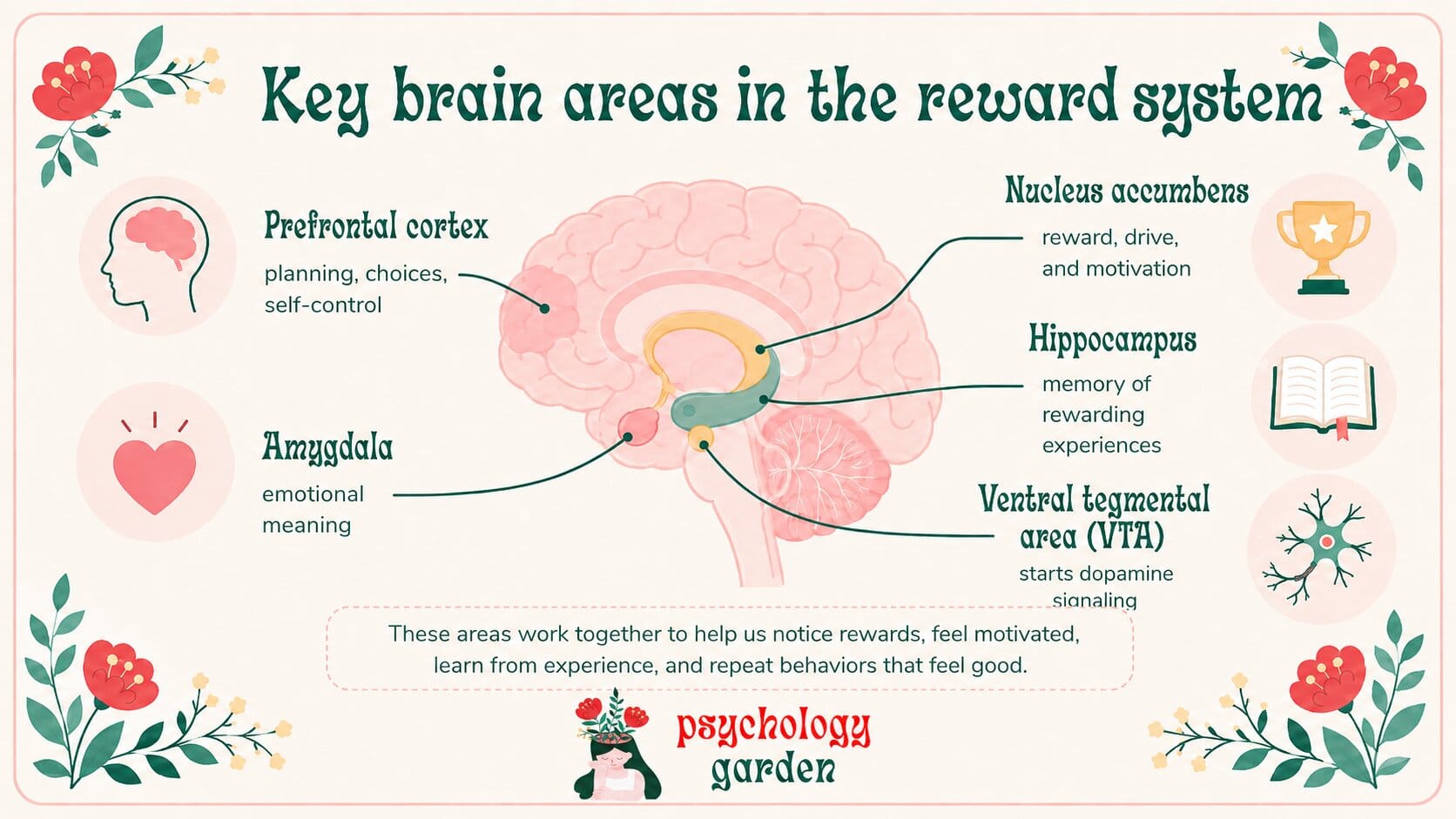
The brain’s reward system is located across several connected brain regions rather than in one single reward center. Key areas include the nucleus accumbens, ventral tegmental area (VTA), prefrontal cortex, amygdala, and hippocampus.
- The ventral tegmental area, or VTA, is one of the starting points. It produces dopamine and sends it to other parts of the brain
- The nucleus accumbens is strongly involved in motivation, pleasure, and reward-seeking behavior. When something feels exciting or worth pursuing, this area is usually active.
- The prefrontal cortex, located at the front of the brain, helps with planning, self-control, decision-making, and thinking about consequences. It helps us decide whether a reward is actually worth it.
- The amygdala adds emotional meaning. It helps the brain remember whether something felt exciting, comforting, scary, or important.
- The hippocampus helps store memories around rewards. For example, it can help you remember where you had a great meal, who made you feel good, or what situation led to a positive experience.
Together, these areas help the brain answer a few basic questions: Was this good? Should I remember it? Should I do it again? Is it worth the effort? These brain regions work together through networks of neurons that pass signals across synapses.
What is the reward center of the brain called?
The nucleus accumbens is often described as an important reward center of the brain because it plays a major role in motivation and reward-seeking behavior. However, there is no single reward center. Reward depends on a wider network that also includes the ventral tegmental area, prefrontal cortex, amygdala, hippocampus, and other regions.
How does dopamine work in the brain’s reward system?
Dopamine helps the brain learn which experiences and behaviors are worth paying attention to or repeating. It can be released when we receive a reward, but it often becomes active while we are expecting one.
For example, imagine you get a notification from someone you like. The excitement may appear before you even open the message. That anticipation is part of dopamine’s job.
This is why the reward system is strongly connected to prediction. The brain is always learning from experience. When something turns out better than expected, dopamine activity can increase. When something is disappointing, dopamine activity may drop.
This process teaches the brain what to seek and what to ignore. A recent study of 42 healthy young adults found that dopamine plays a role in how effort shapes reward learning.
Participants received either a dopamine D2-receptor blocker or a placebo, and the results showed that blocking dopamine disrupted the effect of effort on reward learning. This helps explain why dopamine is not only connected to pleasure, but also to how the brain learns from effort, rewards, and repeated actions.
Reward is not the same as happiness
It is easy to confuse reward with happiness, but they are not exactly the same.
Reward is about motivation and reinforcement. It pushes us toward something. Happiness is a broader emotional state that can include calm, meaning, safety, connection, and satisfaction.
This is why something can feel rewarding in the moment but not make us truly happy afterward. Scrolling social media, eating sugary food, or chasing constant approval can activate the reward system, but that does not always lead to long-term wellbeing.
Because reward and emotion often overlap, it can also help to learn how to understand your own emotions instead of only chasing what feels good in the moment.
The reward system is powerful, but it is not always wise. It responds strongly to quick rewards, especially when they are easy, novel, or unpredictable. A similar pull toward immediately engaging interests appeared in an analysis of 1,100 Reddit comments about ADHD and autism, where Redditors described becoming deeply absorbed in hobbies, games, artists and research topics before their interest shifted.
What is a reward in psychology?
In psychology, a reward is an outcome that makes a behavior more likely to be repeated. Rewards can be external, such as praise or money, or internal, such as satisfaction, enjoyment, or even relief from discomfort. This helps explain why reassurance and repeated checking can become habitual when they briefly make uncertainty feel easier to tolerate.
How does the brain’s reward system create habits?
Habits form when the brain repeatedly connects a cue, a behavior, and a reward. Over time, the cue can begin triggering the behavior automatically, even before we consciously decide to act.
For example:
You feel bored then you pick up your phone. You get stimulation or distraction.
After this happens many times, the brain learns the pattern. Eventually, the cue alone, boredom, can trigger the urge to check your phone.
This does not mean you are weak. It means your brain is efficient. It tries to save energy by turning repeated behaviors into automatic routines. Through the brain’s ability to change, these repeated patterns can become stronger over time.
The same system can support healthy habits too. Exercise, studying, cooking, practicing music, or building a skill can become rewarding when the brain starts associating effort with progress and satisfaction.
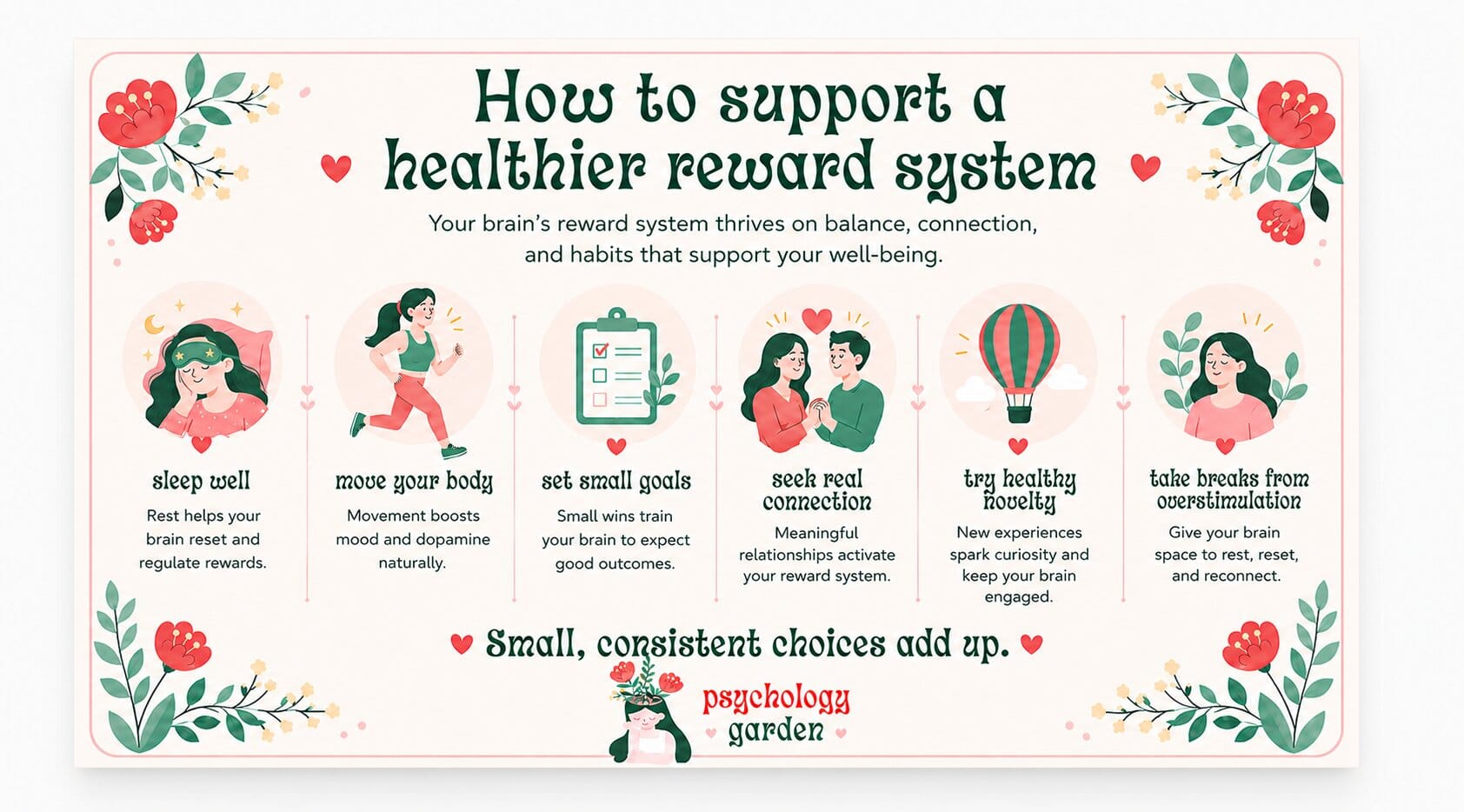
How to support a healthier reward system?
A healthy reward system does not mean avoiding pleasure. It means creating a better balance between short-term rewards and long-term wellbeing.
Small wins are powerful. Completing a task, cleaning your space, taking a walk, or learning something new can all give the brain a sense of progress.
Movement also helps. Exercise can support dopamine, serotonin, endorphins, and other brain chemicals involved in mood and motivation.
Sleep matters too. Poor sleep can make the brain more sensitive to quick rewards and less able to use self-control. It can also help explain why you may have no motivation to do anything, especially when low energy, stress or emotional exhaustion make even simple tasks feel harder to begin.
Novelty is another important factor. Trying a new route, learning a skill, listening to new music, or changing your environment can stimulate the brain in a healthy way.
Most importantly, meaningful rewards tend to last longer than empty ones. Connection, creativity, purpose, mastery, and self-respect may not always give an instant dopamine spike, but they build a more stable sense of satisfaction.
This is also why my mood and happiness report looks at social connection as one of the factors that shape wellbeing, along with health, safety, work, trust, and daily stress.
Final thoughts
The brain reward system is one of the main reasons we learn, grow, connect, and pursue goals. It helps us recognize what matters and motivates us to repeat useful behaviors.
But the same system can also pull us toward quick rewards that do not always serve us in the long run. Understanding how it works gives us more control. Instead of blaming ourselves for cravings, habits, or distractions, we can see them as brain patterns that can be reshaped.
The goal is not to remove pleasure from life. The goal is to choose rewards that make life feel better not only for a few seconds, but in a deeper and more lasting way.
FAQs
The reward system includes areas such as the ventral tegmental area, nucleus accumbens, prefrontal cortex, amygdala, and hippocampus. These regions work together to process reward, memory, emotion, motivation, and decision-making.
Yes, quick rewards can feel good in the moment but may not always lead to lasting happiness. Some rewards give short-term stimulation without deeper satisfaction, meaning, or wellbeing.
Anticipation feels exciting because dopamine often rises before a reward happens. The brain responds not only to the reward itself, but also to the expectation that something rewarding might happen.
Dopamine is important because it helps with motivation, anticipation, learning, and wanting. It does not only create pleasure. It also tells the brain that something matters and may be worth repeating.
The nucleus accumbens is often called an important reward center, but the brain’s reward system is actually a network of several connected regions.
Sources
- Cleveland Clinic – Dopamine: What It Is, Function & Symptoms
- National Library of Medicine – The Brain’s Reward System in Health and Disease
- National Library of Medicine – Dopamine in Motivational Control
- Nature – Cholinergic Modulation of Dopamine Release Drives Effortful Behaviour