
Key takeaways
- Emotions are signals from the mind and body. They can point to needs, boundaries, stress, memories, connection, or change.
- Understanding emotions starts with naming what you feel, noticing where it shows up in the body, and asking what the emotion may be trying to protect.
- Emotions and feelings are not exactly the same. Emotions are the full body-and-mind reaction, while feelings are the part you consciously notice and name.
- Difficult emotions are not always problems to remove. They can give useful information, even when they feel uncomfortable or confusing.
- Responding to emotions means creating a pause between what you feel and what you do next.
Intro
Emotions are signals from your mind and body. They can point to needs, boundaries, stress, memories, connection, or change.
When emotions feel light and pleasant, they may be easy to accept. But when they feel heavy, confusing, or uncomfortable, many people try to push them away before understanding what they are trying to say.
A simple way to picture this is through the movie Inside Out. The film shows emotions as active and meaningful, not as problems to remove. Joy, Sadness, Fear, Anger, and Disgust each have a role, even when they feel uncomfortable.
That is a helpful way to approach your own emotions too. Instead of asking, “How do I stop feeling this?” you can first ask, “What is this feeling trying to tell me?”
What are emotions?
Emotions are whole-bodybody reactions that involve your mind, body, behavior, and attention. They are not just thoughts, and they are not just physical sensations.
For example, fear may come with worried thoughts, a faster heartbeat, tight muscles, and the urge to avoid something. Sadness may bring low energy, slower movement, quiet thoughts, and a need for comfort. Anger may show up as heat in the body, tension in the face, and a strong feeling that something is unfair.
This is why emotions can feel so powerful. They are not only happening “in your head.” They are happening across your body and mind at the same time. These reactions depend partly on how neurons communicate at the synapse passing signals through brain networks involved in emotion, attention, and behavior.
Why do emotions matter?
Emotions matter because they help you notice what feels important, threatening, painful, meaningful, or unresolved.
They can point toward needs, boundaries, memories, values, and relationships. Anxiety may show that something feels uncertain or overwhelming. Guilt may suggest that you acted against your values. Loneliness may reveal a need for connection. Frustration may show that something feels blocked, unfair, or too much.
Emotions are not always perfectly accurate. Feeling rejected does not always mean someone rejected you. Feeling afraid does not always mean you are in danger. Feeling guilty does not always mean you did something wrong, especially when doubt about a past event becomes obsessive.
Still, emotions deserve attention. They may not always tell the full truth, but they usually show that something inside you needs to be noticed.
Emotions are also connected to motivation and learning. The reward system in the brain helps explain why certain experiences feel satisfying, why we repeat some behaviors, and why emotional patterns can become familiar over time.
The difference between emotions and feelings
The difference between emotions and feelings is that emotions are the full body-and-mind response, while feelings are the part of that response you consciously notice and name.
| Term | Simple Meaning | Example |
|---|---|---|
| Emotion | The full reaction in the brain, body, behavior, and attention | Your heart races, your muscles tighten, and you want to avoid something |
| Feeling | The conscious experience of the emotion | “I feel nervous” or “I feel unsafe” |
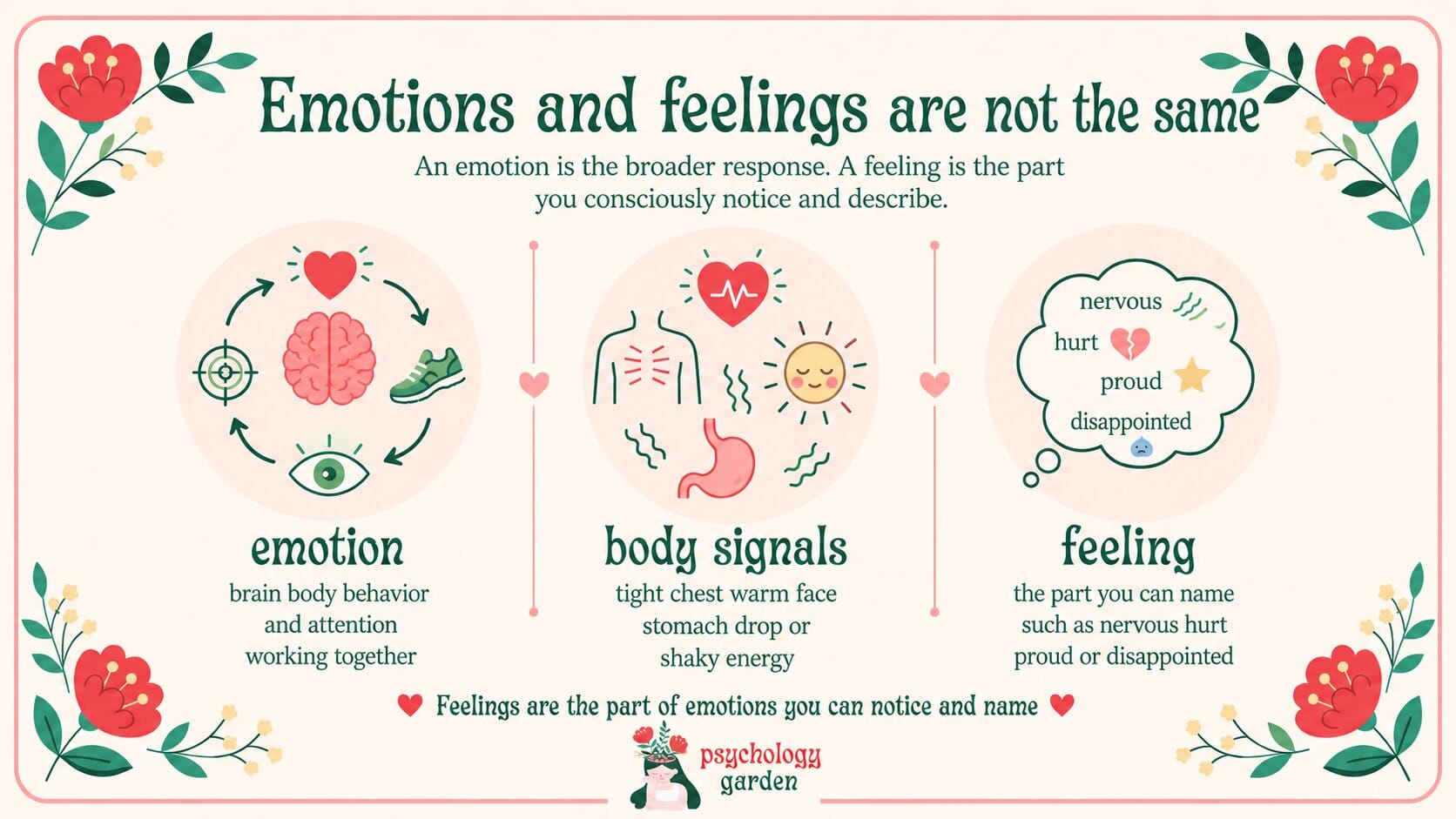
For example, your body may react before you fully understand what you are feeling. Your chest tightens, your stomach drops, or your face becomes warm. A few seconds later, you may realize, “I am embarrassed,” “I feel unsafe,” or “I am disappointed.”
Learning to connect body signals with emotional words is one of the first steps in understanding yourself better.
Start by naming what you feel
One simple way to understand an emotion is to name it.
This sounds small, but it can make a real difference. When we put feelings into words, the emotion often becomes less blurry. Instead of feeling like “everything is wrong,” you may realize, “I feel overwhelmed,” “I feel ignored,” or “I feel nervous about failing.”
Try moving from general to specific.
“I feel bad” could mean sad, tired, ashamed, disappointed, lonely, jealous, anxious, irritated, or stressed. Each word gives you different information.
The more precise the word, the easier it becomes to understand what you might need.
In fact, a 2026 daily-life study on adults found that emotional clarity, or how clearly people understand what they are feeling, is linked to how emotions show up in everyday life. This is why naming a feeling clearly can be helpful when emotions feel messy, heavy, or hard to explain.
Notice where it lives in the body
Emotions often show up physically before they become clear mentally.
Anger may feel like heat, pressure, or tightness. Fear may feel like a racing heart or shallow breathing. Sadness may feel heavy in the chest or face. Anxiety may feel like restlessness, stomach tension, or a need to move.
This does not mean every body sensation has a deep emotional meaning. But noticing the body can help you slow down before reacting.
A helpful question is: “Where do I feel this?”
You do not need to analyze it immediately. Just notice. The body often gives clues before the mind has the words.
Ask what the emotion is trying to protect
Many difficult emotions are protective in some way.
Fear tries to protect you from danger. Anger tries to protect your boundaries or values. Disgust tries to move you away from something that feels wrong or unsafe. Sadness can signal loss and invite support. Shame, even when painful, often appears around belonging, identity, or fear of judgment.
This does not mean every emotion should be obeyed. It means emotions often have a purpose.
Instead of asking, “Why am I like this?” try asking, “What is this emotion trying to protect?”
That question creates more space. It turns the emotion from an enemy into a signal.
Look for the need underneath
Behind many emotions, there is a need. Understanding that need can make the emotion easier to respond to.
| Emotion | Possible Need Underneath |
|---|---|
| Loneliness | Connection, closeness, belonging |
| Overwhelm | Rest, support, structure, fewer demands |
| Anger | Fairness, honesty, respect, boundaries |
| Anxiety | Clarity, safety, reassurance, preparation |
| Hurt | Care, consideration, repair, understanding |
| Sadness | Comfort, time, support, acceptance |
For example, “I feel irritated” might become “I need a break.”
“I feel hurt” might become “I need to feel considered.”
“I feel nervous” might become “I need more preparation.”
When you find the need underneath the emotion, the feeling often starts to make more sense. This can also be useful when you have no motivation to do anything. What looks like laziness may sometimes reflect overwhelm, exhaustion, low mood or a need for fewer demands.
Separate emotions from actions
Feeling something is not the same as acting on it.
You can feel angry without shouting. You can feel anxious without avoiding everything. You can feel jealous without accusing someone. You can feel sad without deciding that life will always feel that way.
This is important because many people judge themselves for having emotions. But emotions are not moral failures. They are inner experiences.
The real choice is what you do next.
Understanding emotions gives you a pause between the feeling and the reaction. In that pause, you can decide whether the emotion needs expression, rest, movement, a conversation, a boundary, or simply time.
Why emotions can feel confusing
Sometimes emotions are confusing because more than one is present at the same time.
You can feel happy for someone and jealous at the same time. You can love someone and feel hurt by them. You can want change and feel afraid of it. You can feel grateful and exhausted. You can feel calm one moment and overwhelmed the next.
This is also why the mood and happiness report in 2026 shows such a layered picture: people can feel more hopeful about their lives overall while still feeling stressed, worried, or emotionally tired day to day.
This does not mean you are being dramatic or inconsistent. Human emotions are layered as I already mentioned.
This was also reflected in an analysis of 1,100 Reddit comments about ADHD and autism, where some Redditors described intense emotional reactions, sensitivity to criticism and the shame that often followed.
A helpful way to think about this is to ask: “What else am I feeling?”
The first emotion is not always the deepest one. Anger may be covering hurt. Anxiety may be covering uncertainty. Numbness may be covering exhaustion. Irritation may be covering sadness.
When emotions feel messy, it may be because they are not one single emotion. They may be a whole emotional stack.
How to respond to emotions?
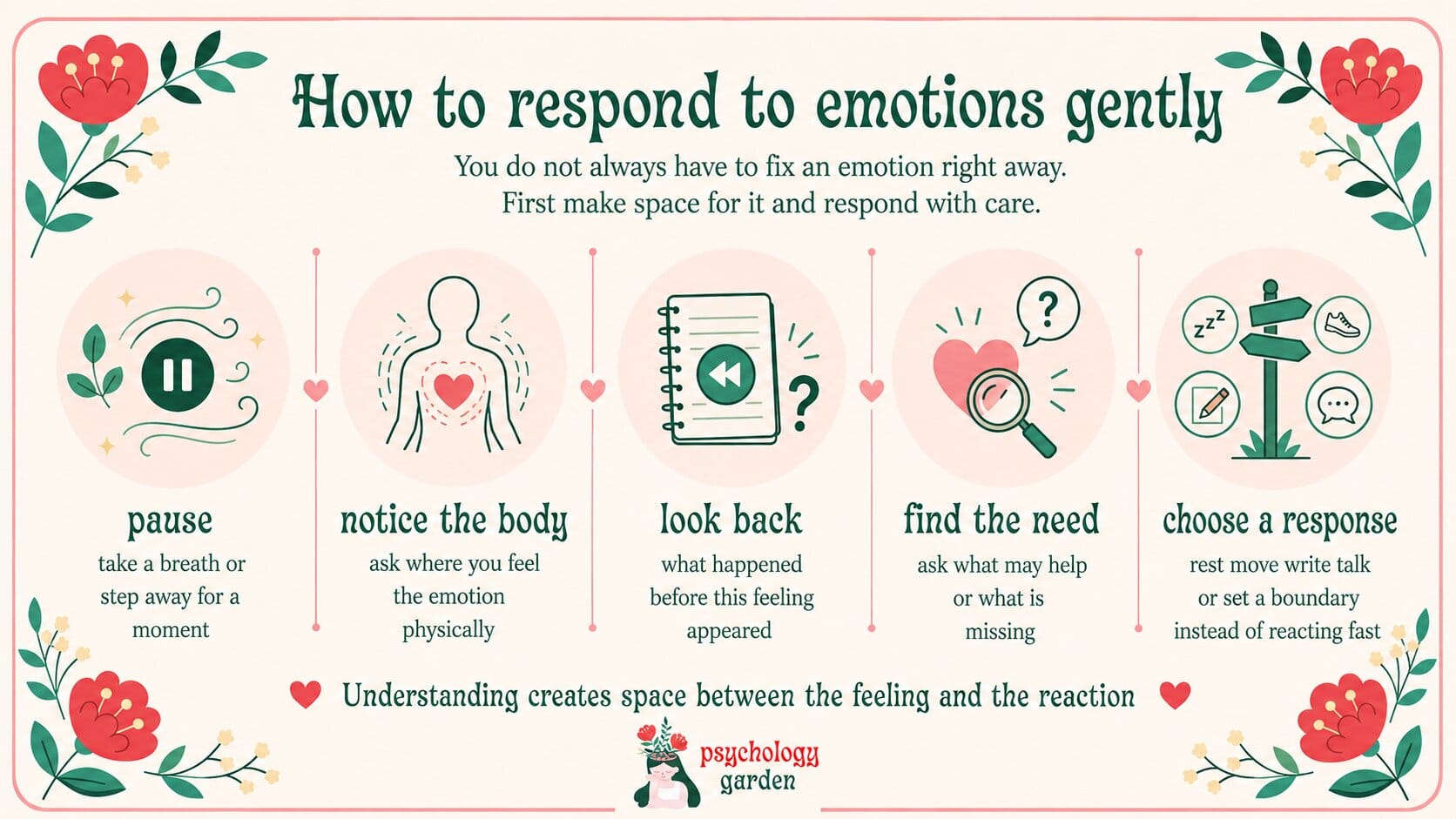
You can respond to emotions by pausing, naming the feeling, noticing the body, looking for the need, and choosing your next action carefully.
You do not always need to fix an emotion immediately. Sometimes the first step is to make space for it. Take a breath. Step away from the situation if you can. Write down what you feel. Go for a short walk. Put your phone down. Drink water. Talk to someone safe. Let the emotion settle before making a decision.
You can also ask yourself:
What am I feeling?
Where do I feel it in my body?
What happened before this feeling appeared?
What need might be underneath it?
What would help me respond instead of react?
These questions do not make emotions disappear, but they can make them feel less chaotic.
Final thoughts
Understanding your emotions is not about becoming calm all the time. It is about building a kinder relationship with your inner world.
Emotions are signals. Some are loud, some are quiet, some are clear, and some are confusing. They can be shaped by your body, memories, relationships, stress, sleep, beliefs, and environment. Through changes in the brain over time, repeated experiences can also make certain emotional responses feel more familiar or automatic.
When you learn to notice them without judging them immediately, you give yourself more choice. You can listen without being controlled. You can feel without reacting too quickly. You can understand yourself without blaming yourself.
The goal is not to remove emotions from life. The goal is to understand them well enough that they can guide you, not overwhelm you.
FAQs
You can understand your emotions better by noticing them instead of pushing them away. Emotions are not random reactions. They can point to needs, boundaries, memories, stress, connection, or change. A helpful first step is to ask, “What is this feeling trying to tell me?” instead of “How do I stop feeling this?”
Your emotions may be trying to show you something important about your inner experience. Fear can point to uncertainty or a need for safety. Anger can show that a boundary may have been crossed. Sadness can point to loss, disappointment, or a need for comfort. Emotions do not always tell the whole truth, but they can give useful signals.
Emotions are the full mind-and-body response, while feelings are the part of that response you consciously notice and describe. For example, your body may react with a racing heart or tight chest before you name the feeling as anxiety, embarrassment, or fear.
Emotions show up in your body because the mind and body respond together. Fear might come with a faster heartbeat, tight muscles, or the urge to avoid something. Sadness might feel heavy, while stress can show up as tension or restlessness. These body signals are part of how emotions prepare us to respond to life.
Sources
- American Psychological Association – Emotions
- Cleveland Clinic – Emotions: How to express what you feel
- Cleveland Clinic – Emotional intelligence
- National Library of Medicine – The importance of emotional regulation in mental health
- National Library of Medicine – The common and distinct neural bases of affect labeling and reappraisal
- Greater Good in Action, UC Berkeley – Naming your emotions
- Science Direct – Evaluating Emotional Clarity and Concordance in Ambulatory Physiological Data and Ecological Momentary Assessments in an Adolescent Clinical Sample
Hi There,
I came across your website and noticed you’re running a WordPress site — great setup.
I just wanted to reach out because we’ve been helping WordPress site owners like you reclaim hours every week by automating the repetitive stuff that quietly eats into your day:
WordPress automation — auto-publishing, content scheduling, plugin updates, backups, and form-to-CRM workflows
Chat automation — 24/7 AI chatbots that answer visitor questions, qualify leads, and book appointments while you sleep
Social media chat automation — auto-replies and DM flows across Instagram, Facebook, and WhatsApp so no lead goes cold
Lead follow-up sequences — instant responses the moment someone fills out a form or contacts you
Most of our clients save 10–15 hours a week within the first month.
We’d love to take a quick look at your current setup and tell you exactly where automation could make the biggest difference — no fluff, no hard sell.
Best,
Alex
AutoHandy Team
[Timestamp: 2026-07-02 20:51:04]