
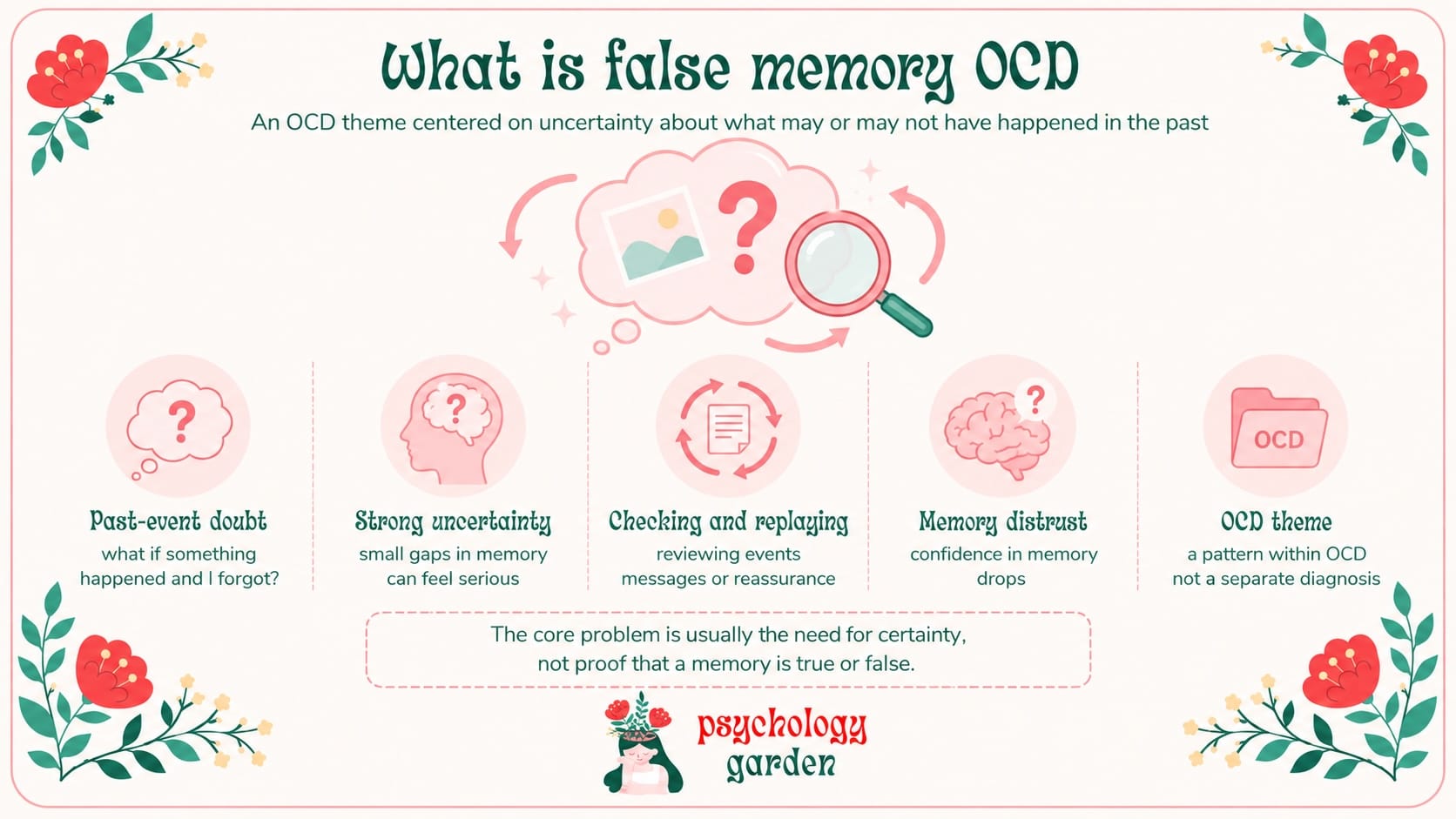
False memory OCD is an OCD pattern where a person becomes stuck on uncertainty about something that may or may not have happened in the past. The memory itself may be vague, incomplete, or based on a sudden thought such as “what if I did something terrible and forgot?” The person then feels driven to work out exactly what happened, often through checking, replaying, reassurance, or searching for evidence.
Key takeaways:
- False memory OCD centers on uncertainty about past events, not necessarily on having an inaccurate memory.
- The biggest problem is often a lack of trust in memory and a strong need to feel completely certain.
- Replaying events, checking evidence, and asking for reassurance can briefly reduce anxiety while keeping the cycle going.
- False memory OCD is not a separate official diagnosis. It is an informal term used to describe a particular OCD theme.
- Treatment usually focuses on reducing compulsions and learning to tolerate uncertainty rather than proving whether a memory is true or false.
Understanding false memory OCD
False memory OCD usually begins with doubt about something that happened in the past. A person may suddenly wonder whether they said something offensive, hurt someone, cheated, behaved badly, or did something they cannot clearly remember. The doubt can become much more upsetting than the original event because the person feels they need a definite answer before they can move on.
The word “false” can also be misleading. Sometimes the feared event probably did not happen, sometimes something real happened but the person becomes obsessed with the details, and sometimes there simply is not enough information to know exactly what happened. What makes the pattern OCD-like is the repeated need to investigate, review, or neutralize the uncertainty.
False memory OCD is not a separate diagnosis with its own criteria. It is better understood as a theme within OCD, where obsessions focus on uncertainty about the past and compulsions are used to try to settle that uncertainty.
How the doubt cycle develops
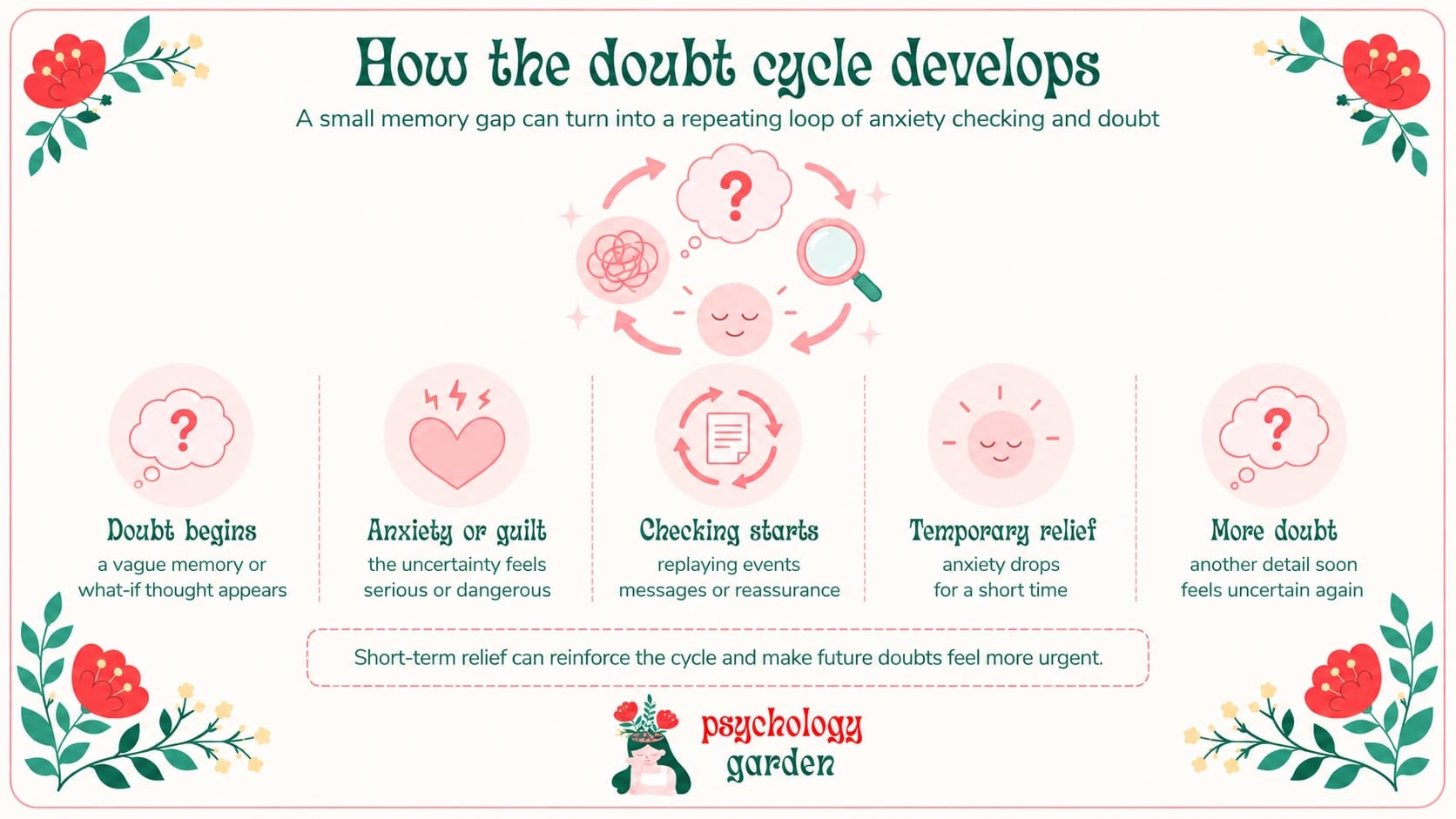
The cycle often begins with a small gap in memory. Someone might remember most of an evening but suddenly think, “What if I said something terrible and just don’t remember it?” That thought creates anxiety or guilt, so they begin trying to solve it by replaying the evening, checking messages, or asking someone what happened.
Those actions may make the person feel better for a short time. The relief usually does not last, however, because another detail can soon become uncertain. This short-term relief can reinforce the behavior, similar to how the brain learns to repeat actions through its reward system and reinforcement processes.
A simple version of the pattern looks like this:
doubt → anxiety or guilt → checking → temporary relief → more doubt
The cycle can become exhausting because the person may genuinely feel as if they are trying to uncover the truth. In reality, the repeated search for certainty can become part of what keeps the obsession active.
Why memory can become harder to trust
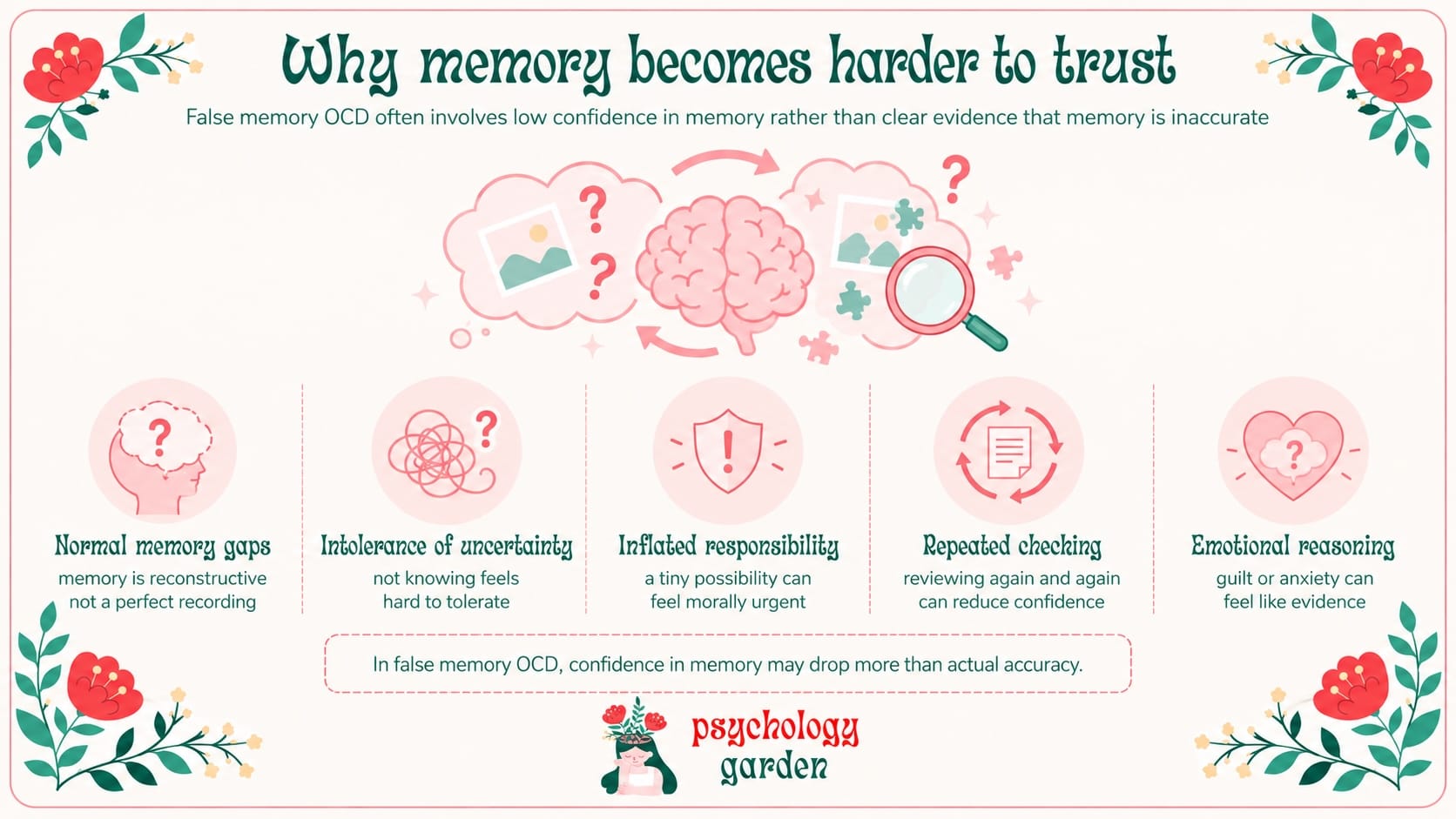
Human memory is not a perfect recording of the past. When we remember something, the brain reconstructs the event from different pieces of information, which means some details can fade, change, or become less certain over time. This is a normal feature of memory and does not mean the brain is constantly creating false memories.
Memory also depends on large networks of brain cells working together rather than one single “memory spot” in the brain. These networks rely on communication between neurons across synapses, which supports learning, memory, and changes in how information is processed.
OCD can make ordinary uncertainty feel much more important. A vague image, strange feeling, or incomplete memory may start to seem meaningful simply because the person keeps focusing on it. The more attention the memory receives, the more familiar and emotionally significant it can feel.
A review published in Psychological Medicine found that people with OCD tend to be less confident in their memory and perception than their actual performance would suggest. In simple terms, the memory itself may not be especially poor, but the person may still feel unable to trust it.
| What research suggests | What it means in simple terms |
|---|---|
| Confidence can drop more than accuracy | You may remember something reasonably well but still feel unable to trust the memory. |
| Repeated checks can blur together | Doing the same kind of checking again and again can make individual moments harder to separate. |
| Responsibility can increase doubt | Feeling that you must be completely sure can make uncertainty feel more threatening. |
| High memory standards can make gaps feel suspicious | Expecting perfect recall can make normal forgetfulness feel like evidence that something is wrong. |
| Anxiety can change how a memory feels | A frightening or morally important thought may feel more convincing because it creates a strong emotional reaction. |
The classic Utrecht University study on repeated checking found that repeated checking can reduce the vividness, detail, and confidence people have in their memory. This helped shape the idea of “memory distrust,” where checking meant to create certainty can end up doing the opposite.
Common signs and compulsions
False memory OCD can involve visible behaviors, but many compulsions happen entirely inside the person’s head. This can make the pattern harder to recognize, especially because people often associate OCD only with washing, organizing, or repeatedly checking doors and appliances.
Common compulsions include:
- replaying the same event repeatedly
- checking old texts, emails, photos, or social media
- asking friends or family what happened
- reconstructing a timeline in detail
- comparing different versions of a memory
- checking whether a memory “feels real”
- using guilt or anxiety as evidence
- confessing something that may not have happened
- avoiding people or places connected with the doubt
Mental reviewing is particularly easy to miss. Someone may look completely calm while spending an hour going through the same conversation in their head, trying to find one detail that finally makes everything certain.
The subject of the doubt can also overlap with other OCD themes. It may involve harm, relationships, morality, sexuality, responsibility, or fear of having made a serious mistake. The content can change, but the underlying pattern of uncertainty followed by checking often remains similar.
What can contribute to false memory OCD?
There is no single known cause of false memory OCD. It appears to involve the broader biological and psychological vulnerability associated with OCD, combined with thinking patterns that make uncertainty about memory especially difficult to tolerate.
One important factor is intolerance of uncertainty. Some people find it particularly difficult to accept that they may never know something with complete certainty. A small gap in memory can then feel like a serious problem that needs to be solved rather than an ordinary feature of remembering.
Another factor is inflated responsibility. A person may feel that even a tiny possibility of having harmed someone or done something wrong deserves immediate investigation. That can turn a vague “maybe” into something that feels urgent and morally important.
Some people may also hold extremely high standards for how memory should work. They may assume that if they cannot remember every detail clearly, something must be wrong. This creates an impossible standard because ordinary autobiographical memory is rarely complete.
Emotional reasoning can make the doubt even stronger. Someone may think, “I feel guilty, so maybe I actually did it,” even though the guilt may have been produced by the obsessive thought itself. Learning how to recognize and understand your emotional reactions can help explain why a strong feeling is not automatically the same thing as evidence.
How treatment works
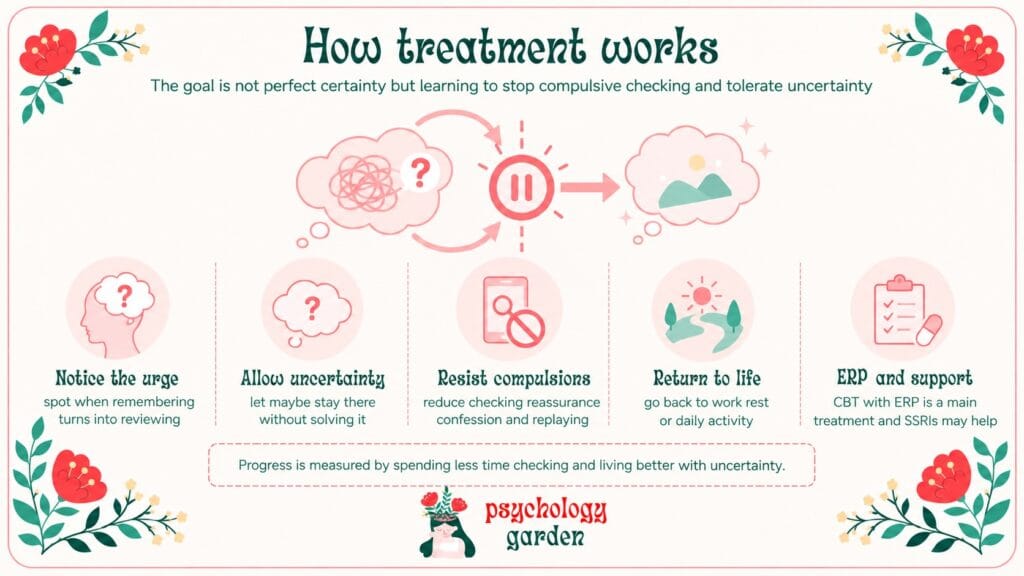
Treatment for false memory OCD usually focuses on the obsessive-compulsive cycle rather than trying to establish whether a particular memory is true or false. The goal is to reduce repeated checking, reassurance seeking, confession, and mental reviewing while helping the person become more comfortable with not knowing everything with complete certainty.
One of the main psychological treatments for OCD is cognitive behavioral therapy with exposure and response prevention, usually called ERP. Exposure involves allowing the uncomfortable thought or uncertainty to be present, while response prevention means resisting the usual action used to make that discomfort disappear.
NICE guidance for OCD recommends CBT that includes ERP as one of the main treatments for OCD, with SSRIs also used depending on symptom severity and individual circumstances. In more severe cases, combined treatment may be recommended.
For someone with false memory OCD, ERP could mean allowing a thought such as “maybe I will never know exactly what happened” to remain unanswered. Instead of replaying the memory for another hour or checking old messages again, the person practices continuing with their day while the uncertainty is still there.
The goal is not to convince someone that nothing happened. Repeatedly trying to prove that a feared memory is false can itself turn into reassurance and feed the same cycle. A more useful treatment goal is being able to tolerate uncertainty without repeatedly trying to solve it.
Over time, repeatedly responding to uncertainty in a different way can make the checking cycle feel less automatic. This connects with the brain’s ability to change through repeated experience, which is one reason new responses can become easier with practice.
Reducing the checking cycle
One useful step is learning to recognize when remembering has turned into compulsive reviewing. Normal remembering usually has a clear purpose and eventually comes to an end, while compulsive reviewing feels repetitive and driven by anxiety. The same question may be investigated again even after it has already been answered several times.
Reducing compulsions can feel uncomfortable at first because the person is no longer using their usual way of calming the anxiety. The uncertainty may temporarily feel stronger, but the aim is to learn that the feeling can exist without needing an immediate answer.
A person might practice noticing the urge to review and then returning to whatever they were doing instead of restarting the memory from the beginning. This is not about forcing the thought away or telling yourself that everything is definitely fine. It is about choosing not to perform another round of checking simply because uncertainty is present.
Progress is usually better measured by behavior than by certainty. Spending less time reviewing, asking for reassurance less often, and returning more easily to work, relationships, or everyday activities can all be meaningful signs of improvement. Trying to measure recovery by asking “How certain am I now?” can simply create another reason to keep checking.
Medication and professional support
Medication can also be used to treat OCD, particularly when symptoms are more severe or significantly interfere with daily life. SSRIs are commonly used as a first-line medication treatment for OCD, although there is no medication specifically designed for false memory OCD.
Some people choose psychotherapy alone, while others may benefit from combining therapy and medication. The right approach depends on the severity of symptoms, previous treatment, other mental health conditions, and personal circumstances. Medication decisions should always be made with a qualified healthcare professional.
Professional support may be worth considering when the doubts take up a large amount of time, cause strong distress, or interfere with work, relationships, sleep, or everyday activities. A clinician usually looks at the overall pattern of obsessions and compulsions rather than trying to decide whether a memory seems convincing.
Not every memory problem should automatically be assumed to be OCD. New or worsening memory loss, major periods of lost time, head injury, seizures, intoxication-related blackouts, disorientation, or other neurological symptoms need a different type of assessment.
Final thoughts
False memory OCD is not simply a problem of having a bad memory. The bigger difficulty is often becoming trapped in the need to know exactly what happened and feeling unable to move on until complete certainty is reached.
Research suggests that memory confidence plays an important role in this cycle. A person can become increasingly unsure without their actual memory becoming equally inaccurate, which helps explain why checking again and again does not always bring the certainty they are looking for.
Recovery does not necessarily mean never having another strange or doubtful thought. A more realistic goal is being able to notice uncertainty without turning it into hours of investigation, reassurance, or mental replay.
FAQs
False memory OCD is an OCD pattern where a person becomes obsessed with uncertainty about something that may or may not have happened in the past. They may repeatedly check, review, or ask for reassurance in an attempt to become completely certain.
There is no single cause. OCD vulnerability, difficulty tolerating uncertainty, inflated responsibility, high expectations about memory, and repeated checking may all contribute to the cycle.
OCD can make uncertain memories, thoughts, and images feel very convincing, but research does not support the simple idea that people with OCD constantly create more false memories. The stronger evidence points toward problems with confidence in memory rather than a large loss of actual memory accuracy.
Treatment usually focuses on reducing checking, reassurance seeking, and mental reviewing while learning to tolerate uncertainty. ERP is one of the main evidence-based psychological treatments used for OCD.
Repeated checking can keep the OCD cycle going and is strongly associated with lower memory confidence. The more someone relies on checking to feel certain, the more difficult it may become to trust the memory without checking again.
OCD symptoms can improve significantly with appropriate treatment. Improvement usually means becoming less controlled by the need to check and more comfortable with uncertainty, rather than reaching perfect certainty about every memory.
Sources
- American Psychiatric Association: What is obsessive-compulsive disorder?
- National Institute of Mental Health: Obsessive-compulsive disorder: when unwanted thoughts or repetitive behaviors take over
- NICE: Obsessive-compulsive disorder and body dysmorphic disorder recommendations
- Cambridge University Press, Psychological Medicine: Are people with obsessive-compulsive disorder under-confident in their memory and perception?
- Utrecht University: Repeated checking causes memory distrust
- Wiley, Depression and Anxiety: False memory and obsessive-compulsive symptoms
- British Journal of Clinical Psychology: A novel intervention to improve memory confidence in compulsive checkers
- International OCD Foundation: Exposure and response prevention
- PubMed: Memory confidence and memory accuracy deterioration following repeated checking